


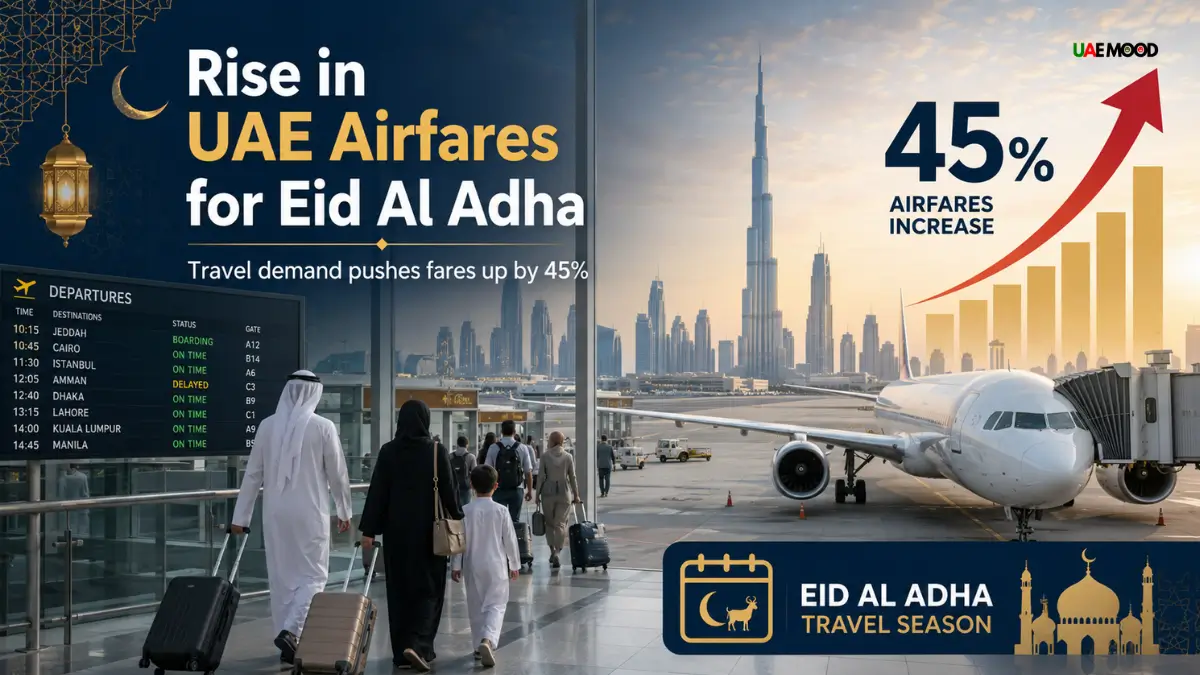
When you log on to your travel site of choice a few weeks before Eid Al Adha, you’re looking forward to seeing a familiar price to Cairo, Beirut or Amman, only to discover that the fare has almost doubled since your previous visit. That’s the tale of thousands of people living in the UAE in 2026.
Eid Al Adha is always a time of heightened travel and one of the most emotional times of the Islamic calendar. The numbers this year however, paint a more stark picture. The average increase in airfares from the UAE to Arab destinations is 45% and in some cases, as high as 60% on the most popular routes, on the peak travel days. This Eid, the financial aspect of travelling is more inescapable than ever before, for families gathering, expats returning home and pilgrims finishing their religious tasks.
Here’s an analysis of the situation: What’s going on with airfares in the UAE, which are the worst hit Arab destinations, why airfares have spiked so much and — crucially — what you can do now to safeguard your travel budget.
Get More Latest Updates o UAEMood
Why Eid Al Adha 2026 brings a huge travel wave?
Firstly, it’s important to understand just how much moving Eid Al Adha causes throughout the UAE.
In 2026, UAE officially announced extended Eid Al Adha holidays for both federal and private sector, which span over several working days, resulting in a rare long weekend that millions of residents use as their main opportunity for travel during the middle of the year. This is not just a holiday for a country with more than 88% of its population being expatriates. It is a homecoming event, a family reunion and an international travel season all in a few days.
- Millions of South Asian, Arab and African employees are able to go home only once per year during Eid Al Adha, as they are expats.
- Arab families on regional tour: UAE nationals and Arab residents cross borders of the Gulf Cooperation Council (GCC) and Levantine countries for family reunions
- Pilgrims heading to Saudi Arabia: Hajj season coincides with Eid Al Adha, creating a lot of traffic to Jeddah and Riyadh
- Time-poor holidaymakers looking for short trips: The long weekend encourages families and individual holidaymakers to get on the plane for international break holidays
- Cultural reconnection trips: Communities from Syria, Lebanon and Egypt see this time as critical family time
There was a 40% increase in travel enquiries made on platforms in the UAE compared to the same Eid period in 2025. Almost 60% of all bookings made this year were for family holidays. It is that magnitude of demand – in a span of five to seven days, they must hit the market – which makes it inevitable that fares will rise.
The Numbers Don’t Lie: How Have UAE Airfares Really Gone Up?
The 45% increase in airfares to Arab destinations is an average over the season. But the real story is in the breakdown of the route-by-route — and some of the numbers are truly amazing.
“Airlines to Arab countries saw up to 60% rise in fares in the days leading up to Eid peak travel, but due to limited supply of seats, demand continued to outstrip the supply,” said Pluto Travels Managing Partner Bharat Aidasani. There were 20–30% increases for standard travel days during the Eid window, with peak departure days resulting in fares reaching their highest levels.
Highlights of the fare for Eid Al Adha 2026 for Arab and regional routes:
- Cairo, Egypt, one of the most sought-after Arab destinations, with fare hikes due to a boom in seat bookings and visa applications.
- Lebanon (Beirut): A perennial favourite for year-on-year demand growth; demand is held up by limited airport capacity in Beirut, which maintains price levels.
- This year is a noteworthy increase in Syria (Damascus) with more Syrians being able to travel home for Eid due to improved access.
- Saudi Arabia (Riyadh/Jeddah): Fares to Riyadh around Dh875 at best; Jeddah was higher, as there was some overlap in terms of number of pilgrims travelling to the kingdom during the Hajj period.
- Morocco (Casablanca/Marrakech): One of the Arab countries that has seen the highest percentage rise this Eid season
- Bahrain and Muscat (GCC): Short-haul GCC fares are still around Dh1,100 and represent a significant increase over off-peak prices.
- Emirates added direct capacity to both Kuwait and Amman to meet demand, though fares are still higher than historical averages.
The early-booking gap is also crucial. A ticket sold 40-45 days ahead for Dh500 may end up selling for more than Dh1,000 — or even higher — a few weeks before a flight leaves. If you’re a family of four, the difference between making an early booking and making a late booking can be thousands of dirhams.
There are Three Reasons for the High Airfares in the UAE Right Now
This average fare increase of 45% is due to a combination of factors. It can be seen as a combination of three pressures: demand pressure, capacity pressure, and fuel pressure.
- Surge in Demand Outstripping Supply
The UAE’s post-COVID travel recovery has been coming year after year. Since 2022, outbound travel demand has increased at a rate of 20-25% per year. By 2026, this is the extent of the compounding effect: the travel appetite of UAE’s residents is much bigger than the size of aviation infrastructure, originally designed to cater to peak travel times.
60% of travellers are now willing to book 3-5 weeks in advance in order to avoid the last minute price increases.
The number of group tour bookings has increased by 10%, with travellers looking for shared-cost convenience during periods of high costs.
Women-only travel groups are a new segment that is increasing by 15% year-on-year, creating new demand to crowded lines
- Flight Capability has not Caught Up
Dubai, Abu Dhabi and Sharjah airlines are operating at almost full capacity. Adding flights in the weeks leading up to Eid is more of a challenge than it sounds due to slot restrictions at key airports, crew availability issues and planning windows.
Meanwhile, Emirates responded to the 2026 Eid demand by introducing 13 additional flights on existing regional routes, namely to Amman, Dammam, Kuwait and Bahrain, but these extra flights are still not enough for the demand. flydubai is also busy expanding its operations with CEO Ghaith Al Ghaith emphasising the airline’s resolve to ensure both capacity growth and operational reliability. Despite all these additions the available seating capacity is still structurally less than what travellers desire during the Eid window.
- A Global Fuel Problem, which Raises Operating Costs
Maybe the biggest — and most uncontrollable — cause of the airfare spike in 2026 is what’s been happening to the price of jet fuel. Jet fuel prices jumped from about $85-$90 per barrel earlier this year to around $150-$200 per barrel leading up to the Eid travel period, as a direct result of the region’s instability, and geopolitics in general, around the Strait of Hormuz. There is no way to absorb such a cost increase by an airline without it being passed on in the form of higher fares.
The fuel crisis is not just a UAE issue. The International Energy Agency has sounded alarm bells over the amount of aviation fuel in European inventories. The impact for short-haul flights in the Arab region is also tangible, as additional fuel costs are directly added to the base fare of each ticket sold.
Look at Popular Arab Destinations
The demand patterns of Eid Al Adha demonstrate a distinct hierarchy for Arab destinations; some of them are of cultural association, others are of religious obligation and others are due to re-gained accessibility.
Egypt, which continues to be the top Arab destination in terms of bookings, has seen a huge surge in the number of applications to obtain an Egyptian visa in the Eid window, travel agents said.
Syria is the top new story of 2026. The Syrian community in the UAE is on an unprecedented voyage home this Eid, having had little opportunity to travel for years, and fare increases on flights to Syria from the UAE are among the highest this year, owing to thin capacity.
Despite the economic uncertainty, Lebanon has been a favourite option. The emotional attraction of Beirut is such that both local and foreign tourists, who travel to the region, and Lebanese expats, do not take it off the Eid travel map year after year.
Saudi Arabia is a dual-demand market; pilgrims who have to do the Hajj and the normal holiday takers travel together and the routes from Riyadh, Jeddah and Dammam are at premium prices throughout the Eid season.
Morocco has now become a burgeoning long-haul Arab destination, to which UAE residents are going for the Arabic language, culturally rich environments and good hospitality infrastructure – Casablanca and Marrakech are among the top destinations.
Airlines’ Response to Eid Al Adha Demand Surge
But the UAE’s big airlines haven’t been sitting still as the demand surge has taken place. Each has acted in accordance with its network strengths and capacity for action.
- Emirates: An additional 13 flights were added across its regional network during Eid focusing on high demand routes to Amman, Dammam, Kuwait and Bahrain. Now flying to 137 destinations in 72 countries.
- Flydubai: Making rapid expansion and a commitment to operational reliability while managing limited slots and crew availability to be their top priorities.
- Air Arabia: Reopened to Alexandria, Cairo, Yerevan, Bahrain and various Indian cities. Opening new leisure destinations such as Baku, Almaty, Tbilisi, Tashkent and Yerevan.
- Etihad Airways: Operating a full commercial network that includes around 80 destinations in the Middle East, Africa, Asia, Australia and Europe — offering important options for travellers based in Abu Dhabi.
Despite these increases, the gap between demand and supply will not be overcome in the short term in the airline sector. The industry message is clear: more capacity is good, but it is small to a structural shortage.
How the Fare Surge Affects Your Holidays Budget
The average increase in airfares of 45% is not in isolation. It changes the real choices of real families. Here are some of the travel agent observations from the UAE regarding traveller behaviour for this Eid season:
- Destination substitution: Premium Arab routes are being replaced by lower-priced options within the region by some travellers.
- Trip shortening: Families opting for a three-day vacation rather than a five-day one, to avoid some of the costs that add up to the price increase of the flight.
- All-inclusive package uptake: Package holiday bookings grew 30% year-on-year, as people believe that packaged pricing better cushions volatility of fares
- Group pooling, with the number of group tour bookings rising by 10% is due to families and friends travelling together to share the costs.
- Budget reallocation: This means spending less at the destination and more on activities, or less on meals at the destination to afford higher airfares.
Many residents in the UAE are just saying “no problem” to higher rates of fare and booking anyway, and the cultural and family value of Eid trumps financial pain.
Period of the Year When Airfares are Usually Higher
This is a time of year that typically sees airfare hikes.
While you can’t do much about the prices or the number of airlines, you can certainly do something about the timing and means of booking. Travel experts offer these tips:
- Book 40-45 days in advance: Industry professionals have reported that you could save up to 50% on your ticket price by booking it 40-45 days in advance when compared to buying it three weeks before leaving for your trip.
- Fly on shoulder days: Flying mid-holiday can save 15-25% – the day Eid starts and the day before it ends are the most expensive departure points to fly on.
- Compare between UAE airports; there are cases where prices from Abu Dhabi (Etihad’s hub) and Sharjah (Air Arabia’s hub) are lower for the same routes than Dubai prices.
- Use fare tracking platforms: Tools such as Wego, Skyscanner, and Google Flights can be used to keep an eye on certain routes and alert you to lower fares.
- For more flexible visitors, there could be room for another airport to be considered, such as Amman rather than Beirut or Alexandria rather than Cairo as less popular airports.
- Bundle into packages: All-inclusive packages will help you avoid individual component price increases — when the flight becomes more expensive, the bundle price does not necessarily increase.
- Travel Mid-week: Within the Eid window, Tuesday and Wednesday departures always offer lower fares than do Friday, Saturday and Sunday departures.
One Year Blip or the New Normal?
The quick answer is yes and no. Some of the factors behind 2026’s fare increase are fleeting and could be alleviated in the months ahead with a calmer energy market and more stable geopolitical conditions. However, the structural narrative is long-term and incremental growth in UAE outbound travel demand that will not fade away.
The UAE aviation industry is moving into a sensitive period, as travellers’ demand is outstripping the infrastructure that it has to accommodate at busy times. But, unless there is a major influx of new planes (which is unlikely to happen given the global economic climate), new airport facilities (which is unlikely to happen given the global economic climate) and new routes (which is unlikely to happen given the global economic climate), Eid Al Adha is likely to remain one of the most costly and competitive travel windows in the UAE calendar for the foreseeable future.
At the moment, the traveller who plans his itinerary well, who remains flexible with his plans and who thinks outside of the box in terms of routes and departure times will always outperform the traveller who waits.
Conclusion: Plan Smart, Travel Well This Eid Al Adha
The 45% increase in airfares in the UAE to Arab destinations for Eid Al Adha 2026 is factual, substantial, and impacting hundreds of thousands of people all around the country. It’s not a reason to stay home, however.
Eid Al Adha is one of the most significant travel seasons in the UAE calendar – and for many families, there’s no cost between them and loved ones. What discerning tourists have discovered is to book earlier, shop around carefully, and utilize all available resources to get the most out of their money.
Book early. Fly smart. Celebrate well.
FAQ’s
Q1: What is the increase in airfares to Arab countries in UAE for Eid Al Adha 2026?
A: Arab destinations are up an average of 45%, in peak travel days, even more, depending on the destination.
Q2: What are the most expensive places to fly to from the UAE during this Eid in the Arab world?
Arab destinations such as Egypt, Morocco, Syria, Lebanon and Saudi Arabia have the highest hike in their fares as they approach Eid Al Adha 2026.
Q3: What are the reasons behind the high price of flights in UAE during Eid Al Adha?
Three key factors are behind the surge: a record level of travel demand, limited supply of airline seats and a global jet fuel price crisis due to geopolitical uncertainty in the Strait of Hormuz.
Q4: When is the best time to book Eid Al Adha flights from UAE?
A: Travel experts suggest booking at least 40-45 days in advance. This early booking can save you almost 50% off last minute bookings.
Q5: Is there any other option than flying directly to Arab countries during Eid and is it cheaper?
A: Yes. They can look for flights from Sharjah, or Abu Dhabi, or check for connecting flights, which can be less popular Arab hubs with lower overall cost.
Q6: What are the additional carriers to operate flights to the UAE for Eid Al Adha 2026?
A: Emirates launched 13 new regional services to Amman, Dammam, Kuwait and Bahrain, while flydubai and Air Arabia are also expanding capacity to key destinations.
Q7: Would it be better to book flights and hotels separately or opt for an all inclusive?
A: Yes, for many travelers. Fixed pricing and protection from individual component price increases make it easier to budget the combined pricing during high-fare periods due to all-inclusive packages.
Q8: On which day is it most affordable to travel during the Eid Al Adha holiday period?
A: The middle of the holidays is always less expensive than the first and last day of the Eid vacation, which are the hottest and most popular days.
Q9: Are airfares in UAE going to decrease after Eid Al Adha 2026?
Fares should cool a bit following the Eid, but will likely remain high through the summer as jet fuel continues to command high prices and outbound demand remains strong.
Q10: Where can I find the best deals for Eid Al Adha flights from UAE?
A: Take advantage of fare alert features on travel apps like Wego, Skyscanner, or Google Flights to track specific routes and get alerts if fares change. It is also advisable to compare prices among various booking platforms.
Read Another News: Parkin to Enforce Parking Rules at Dubai Mall and Two Other Emaar Malls