

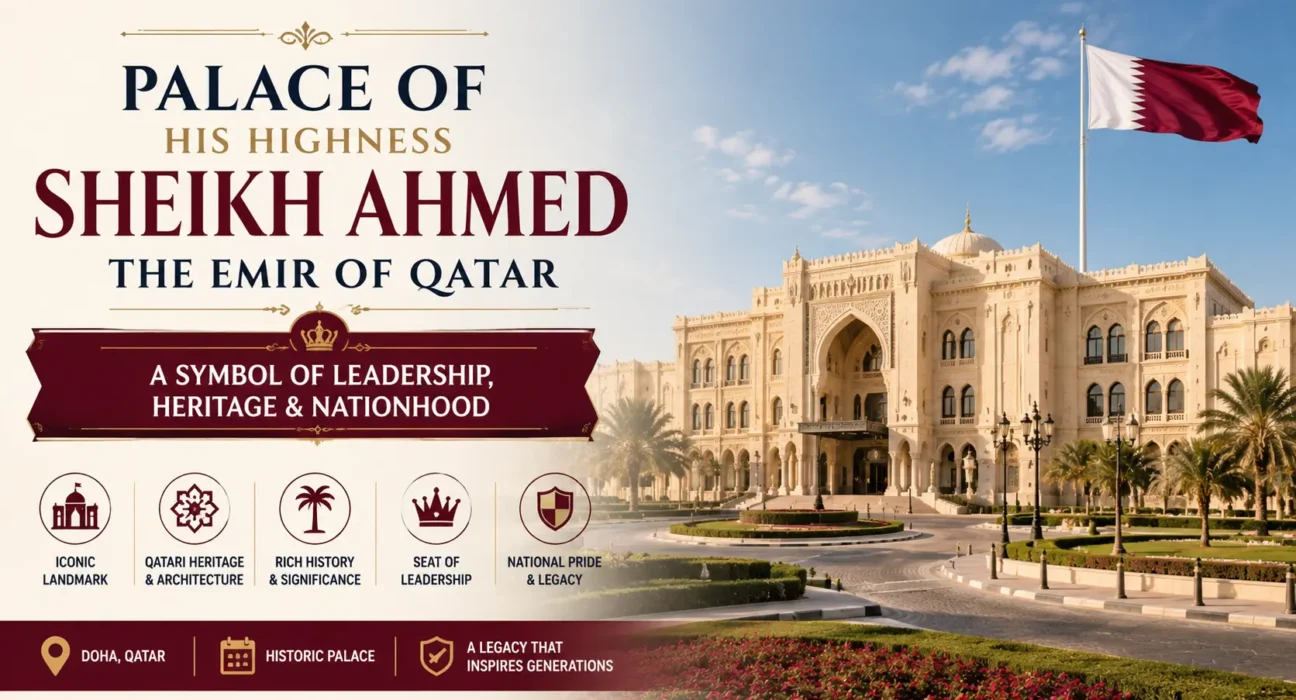
Not many buildings represent the whole nation like the Palace of His Highness Sheikh Ahmed the Emir of Qatar. This royal compound is more than just a building; it is a symbol of sovereignty, tradition, and the visionary leadership of its creators. It is a living monument to the evolution of Qatar from a small settlement of pearl divers in the Gulf to one of the most influential countries in the modern Arab world.
The name “Sheikh Ahmed” is derived from one of the most significant periods in Qatari governance history. Sheikh Ahmed bin Ali Al-Thani was the Emir of Qatar from 1960 to 1972, when the country was just beginning to discover its astounding success. How he and Qatari rulers combined the traditions of Arab hospitality with the demands of statehood is reflected in his legacy – and in the palaces that served his rule.
The article delves into the palace’s historical origins, architectural splendor, diplomatic function, cultural significance, and lasting heritage, providing a complete picture of a royal residence that played a pivotal role in shaping a nation’s identity.
Who is the Emir of Qatar Sheikh Ahmed?
The appreciation of the palace in its full significance is possible only in the light of the man behind it. Sheikh Ahmed bin Ali Al-Thani was born into the powerful Al-Thani royal family which has ruled Qatar since the mid-19th century. In 1960 he became Emir and ruled until 1972, a time when Qatar gained its formal independence from British protection in September 1971.
Sheikh Ahmed was a leader of a transformative decade, one of the most in the history of the Gulf. During his reign, Qatar’s petroleum resources were discovered and monetized for the first time, and the country started to support massive infrastructure, education and social development. During his tenure, Qatar made significant strides towards emerging as the thriving and well-known nation it is today.
His attitude to governance was very traditional Qatari, that is, to be generous, to be a Muslim, to belong to the tribe and to be committed to the people. His palace was not only for his personal use, but also served as the hub of the Emir’s state affairs, the place where foreign dignitaries were welcomed, and the seat of national customs.
The Palace’s History
The palace linked to Sheikh Ahmed has a complicated and storied past, a testament to Qatar’s dramatic transformation as an independent sovereign state. This palace was not a thousand-year old structure like many royal residences, but a structure that was constructed at a time when the country was rapidly expanding — a structure in the middle of tradition and modernity.
History indicates that the Emir ordered the palatial complex to be built in order to mirror his vision of Qatar’s role within the Arab world and on the international stage. It was built by both skilled craftsmen and engineers, who used regional Islamic architecture and were influenced by the new technologies of the mid-20th century.
Interestingly, Mapcarta and historical maps also show the presence of a palace compound for Sheikh Ahmed in the Bur Dubai area of Dubai, close to Al-Maktoum Stadium and the historic Dubai Creek waterfront. This is a sign of the close relationship between the Gulf’s royal families and the UAE, where Qatari royals used to have secondary homes as a symbol of inter-Gulf fraternity and personal relations.
Meanwhile, Qatar’s royal history revolves around the Amiri Diwan in the capital of Doha, the seat of the Qatari Emir’s authority, dating from several generations of the Al-Thani family. Both of these aspects of Sheikh Ahmed’s palace narrative — his Qatari governance and his Gulf connections — form a portrait of royal life in the early stages of Qatar’s emergence.
Localisation and strategic context
The location of the palace has always been a key factor to its role. Both the historical house in Doha and the documented compound in Dubai’s Bur Dubai were carefully selected for their symbolic and functional benefits.
Royal Palaces have always been located in close proximity of the Corniche, the iconic seafront boulevard that runs along the Arabian Gulf in Doha. This location provides the compound visibility, access to official delegations and a close vicinity to governmental institutions. Moreover, the palace is easily accessible to cultural hotspots like Souq Waqif, a traditional market located at the heart of Qatari culture, and the Museum of Islamic Art, which is one of the leading collections of Islamic artifacts in the world.
The palace compound in Dubai, with its careful placement, has been documented both near Al-Maktoum Stadium and along the Al Seef waterfront, at Dubai Creek. The Bur Dubai district is historically one of the most important cultural and administrative areas in the UAE and therefore it was a natural choice for the royal standing of Qatari.
This twofold geography, so much more local than regional, is characteristic of elite royal life in the Gulf: very local in its identity, but still regionally connected in its practices.
The architectural style is a blend of traditional and modern elements, creating a unique and harmonious structure.
One of the palace’s most renowned features is its blend of classic Qatari architectural elements with contemporary style. This fusion is no coincidence, it is an architectural thought that is as much in line with the vision of the Emir for Qatar as a country proud of its heritage but looking boldly at the future.
The traditional architectural elements of Qatar.
The palace is inspired by many architectural styles of the Islamic world of the Arabian Peninsula, including:
- Wind towers (barjeel): Pre-air conditioning wise use of natural breezes of the Gulf by channeling it into interior spaces.
- Ornate wooden lattice screens (mashrabiya): These decorative, geometric wooden screens allow light into a room while providing privacy and are very decorative in themselves.
- Arched doorways and porticos: grand entrances with pointed Islamic arched doorways carved in pale limestone and with detailed geometric work.
- Open air courtyards (sahn): Central open space areas that provide natural light to the interior rooms, and provide natural cooling.
- Domed ceilings: Tall domes inside that make a grand space that lessen the warmth.
Contemporary additions and infrastructure.
On top of this classic base have been integrated the best modern systems:
- As a result of the extreme desert heat in Qatar, advanced climate control systems have been designed.
- Intelligent surveillance and built in security systems
- Formal Conference and Diplomatic Session Meeting Halls – Acoustically designed.
- Giant gardens that are lighted and have a system in place for sustainable water use.
- Private helipad and safe vehicular access routes for state-level arrivals.
The end product is a palace that celebrates the past and operates at the forefront of modern governance – a kind of metaphor for Qatar’s own national identity.
Main interior elements and Royal Chambers
The interior of the palace is designed to showcase the power and wealth of the monarch, with each room serving a specific purpose and being designed to impress. Key spaces include:
- The Grand Reception Hall: The ceremonial centre of the palace, where heads of state, ambassadors and foreign dignitaries are officially received by the Emir. The hall is decorated with hand-knotted Qatari carpets, crystal chandeliers and gold calligraphy panels with verses from the Holy Quran.
- Majlis Chamber: A traditional sitting room of the Arabs for informal but important meetings. Here, always, Arabic coffee (qahwa) and dates are served, corresponding to the strong traditional Qatari culture of hospitality (diyafa).
- State Conference Rooms: They are designed with simultaneous translation services and secure communication technologies, and are used for bilateral and multilateral negotiations.
- The royal family’s private apartments, known as the Private Royal Apartments, showcase the luxurious combination of Arabian opulence and personal comfort.
- The Library and Archive: A curated collection of historical documents, rare manuscripts and contemporary research materials that trace Qatar’s political and cultural evolution.
- The Palace Mosque: a beautifully fitting private mosque for the Emir and royal household where they pray daily, decorated with Quranic quotations and handcrafted tilework.
Governance & State Affairs
His Highness Sheikh Ahmed’s Palace was not just a house, it was a tool for governing. Qatar is a constitutional monarchy headed by the Al-thani family, who have executive power in the nation’s internal and external policies.
Issues of national significance were drawn up and discussed from the formal rooms of the palace.
- Funding for education, health and infrastructure.
- The roles played by Qatar at the international organizations such as the United Nations and the Arab League
- Economic treaties with other nations and international companies
- Strategic policies to manage Qatar’s increasing natural gas wealth.
The palace was the material symbol of executive authority, and the business of state was transacted within its walls, amid Islamic art, Qatari culture and royal hospitality.
Diplomatic Significance: A platform for world leaders
Perhaps none of the palace’s functions is more significant than that of a diplomatic link between Qatar and the world. The palace has welcomed heads of state, prime ministers, foreign ministers, and international business leaders alike, further cementing Qatar’s reputation as a respected and influential regional player.
The sumptuous state dinners at the palace’s impressive dining rooms are carefully planned, combining the best of Qatari cuisine with internationally recognized diplomatic etiquette. It’s a true taste of Qatari hospitality with warm welcome, generous servings, and the traditional ‘Fahim’ coffee and frankincense.
These visits are not of a ceremonial nature. In palace palace walls, real negotiations have molded:
- Energy deals that provide gas to markets throughout Europe and Asia.
- Efforts in the region to create peace through mediation that centered on Qatar.
- International institutions on Qatari soil through cultural and educational partnerships.
As a meeting room, the palace has been one of the most important in the Gulf.
Traditions of culture and religion in the walls
The palace is not only a symbol of governance and diplomacy but also a place where the cultural and religious heritage of Qatar continues to flourish. The palace calendar is based on the Islamic hijri year with special events occurring in:
- The palace is opened during Ramadan for formal Iftars, where government officials, scholars, tribal elders and guests break the fast together in the spirit of community.
- Eid al-Fitr and Eid al-Adha: Celebrations characterised by lavish gifts, music and traditional entertainment, reflecting the family’s rich cultural heritage as the custodians of the Al-Thani family.
- Qatar National Day (December 18): The palace serves as the heart of national pride, and the grounds host ceremonial events, military parades and public celebrations.
The palace is a living museum of Qatari creative heritage, with artisans’ works on display proudly inside, ranging from hand-painted ceramic tiles to woven Qatari fabrics.
Security and Royal Protocol;
As a house of royalty and a focal point of state activities, the palace has multiple layers of security to ensure that it’s open and accessible to official persons while at the same time affording maximum security to the royal family and visiting dignitaries.
Security arrangements include:
- High definition perimeter surveillance systems on all perimeters.
- Special guard forces with well-trained members
- Vehicle and pedestrian controlled access checkpoints for official access point(s)
- All official state events will be coordinated with the State Security apparatus of Qatar.
- Visiting Heads of State protocols such as safe motorcade routes, safe communications facilities, etc.
With this security apparatus in place, the palace retains a long-standing tradition of the Gulf, which is known as the “Majlis of the People”: ordinary Qataris can present petitions and concerns directly to the Emir.
The Palace and its contribution to the contemporary identity of Qatar.
The palace of Sheikh Ahmed has been a symbol of continuity and national pride as Qatar has developed into one of the world’s wealthiest and most diplomatically active countries, hosting the 2022 FIFA World Cup and supporting large-scale international cultural events and serving as a key mediator in regional conflicts.
It is the source of the modern identity of Qatar: Islamic, Arab and proud of its international participation. The palace is a physical link between centuries as it represents Qatar’s relatively recent independence as a nation and its much older tribal and cultural heritage.
New generations of Qatari leaders see in the legacy of Sheikh Ahmed and his time as a leader a vindication of the idea that modernization need not be at the expense of identity, that a small Gulf state can compete on the world stage without losing the soul of its heritage.
Local points of interest and attractions.
The palace’s overall context enhances its cultural value. Some of the important landmarks around the neighborhood are:
- The famous traditional market of Doha, Souq Waqif, where you can find local spices, handicrafts and even authentic restaurants of Qatar.
- The Museum of Islamic Art (MIA) is one of the best museums of Islamic art in the world, designed by I.M. Pei, and built to house 1400 years of Islamic art.
- Corniche, the picturesque water front promenade with a view of the Arabian Gulf in Doha city
- A cultural village that has become a hub for international cultural exchange, arts, and theater.
- Al Waqif Mosque: A historic mosque built to the traditional Qatari religious architecture.
Conclusion: A Palace That Built a Nation
The Palace of His Highness Sheikh Ahmed the Emir of Qatar is more than just stone, mortar and marble. It’s a monument to a vision, and the vision was that of a leader who shepherded a tiny Gulf sultanate through defining years that saw its emergence as a modern sovereign power.
Whether it’s its majestic Islamic arches, its handcrafted interiors, its state-of-the-art governance facilities or its world renowned diplomatic halls, the palace embodies all that makes Qatar extraordinary: a perfect and self-assured blend of ancient tradition and forward-thinking ambition.
The legacy of Sheikh Ahmed and the palaces that served as his creations throughout his reign will forever be a part of Qatar’s national history as the country moves towards the future as a cultural patron, an energy powerhouse, a mediator of peace and a host to the world.
Frequently Asked Questions (FAQs) are available to assist with answers to common questions
Sheikh Ahmed the Emir of Qatar is?
Sheikh Ahmed bin Ali Al-Thani was the Emir of Qatar from 1960 to 1972, which included the important years of Qatar’s independence in 1971.
2. In which place is located the Palace of Sheikh Ahmed?
The palace is linked to places in Doha, Qatar and the presence of a royal palace of his name in the Bur Dubai area in Dubai, next to Dubai Creek and Al-Maktoum stadium, is confirmed in historical documents.
What is the Amiri Diwan? 3.
The Amiri Diwan is the official palace and administrative office of the Emir of Qatar, in the heart of Doha. It is the seat of the major governmental power and State diplomacy of Qatar.
4. What architectural style is the Palace built in?
The palace is a mixture of traditional Qatari-Islamic architecture – arched doorways, wind towers, mashrabiya screens, open courtyards – and modern engineering and state-of-the-art systems.
5. What was the greatest thing Sheikh Ahmed did?
One of his most significant contributions is serving as the first Emir of Qatar after the official announcement of the country’s independence from Britain on 3rd September 1971.
6. Is it possible to visit the palace?
The compounds of royal palaces in Qatar are not in general accessible to the public. The Qatari tradition of an open Majlis however, enables the people to interact with their leaders in designated areas.
7. What is palace’s function as a diplomatic institution?
It is the main venue for hosting state dinners, bilateral and multilateral negotiations, and is the premier venue for receiving foreign heads of state and international dignitaries in Qatar.
8. What function does the palace serve in the Islamic festivals?
The palace is used for formal Iftar functions during the period of Ramadan and for large-scale receptions during Eid festivals, which are an integral part of the cultural life of Qatar and the Al-Thani family and illustrate the Islamic roots of the Qatari people.
9. Which culture shops are in the immediate vicinity of the palace area?
The Museum of Islamic Art, Katara Cultural Village, the Doha Corniche and Souq Waqif are some of the leading attractions in the vicinity, reflecting the city of Doha’s rich cultural landscape.
10 What are the importance of the palace in today’s Qatar?
The palace embodies the values of Qatar, which are faith, tradition and progress, and is a symbol of the nation’s evolution from a small Gulf emirate to a country with global influence.
Read Another Topic: Al Hamriya Beach: The UAE’s Undiscovered Coastal Delight