

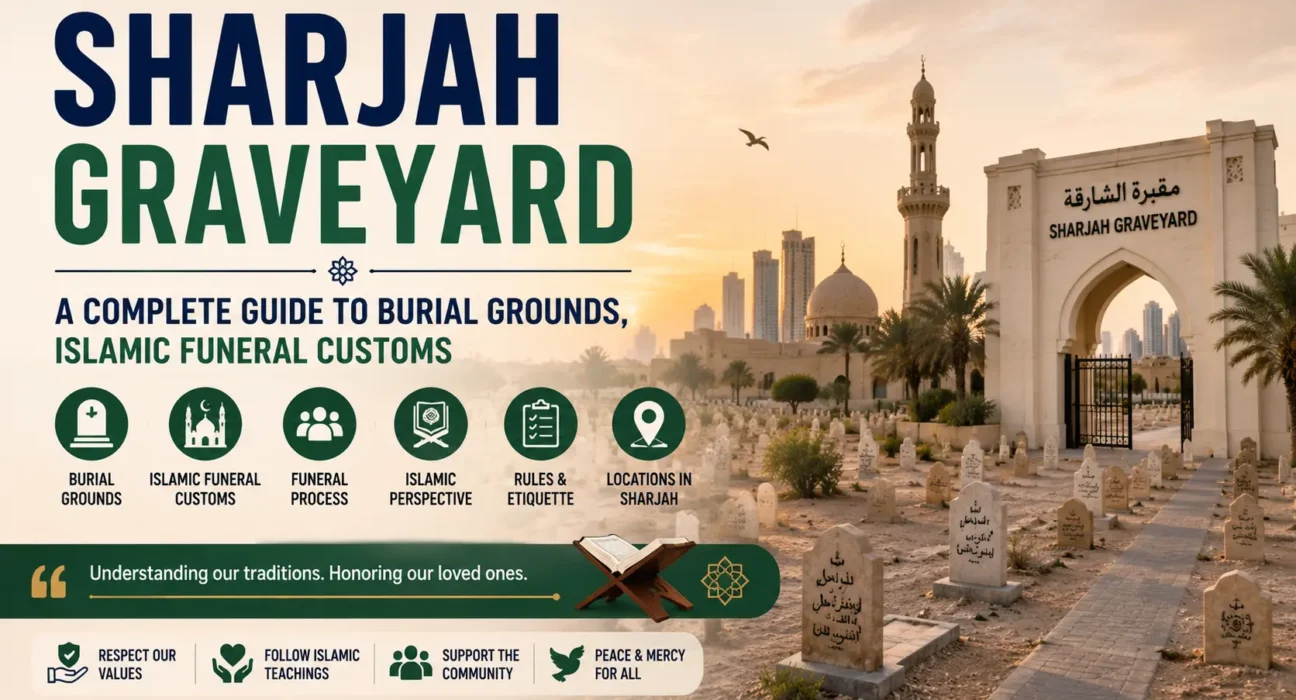
The United Arab Emirates’ most culturally significant emirate, Sharjah has a profound reverence for life, death and beyond. Sharjah graveyards are not just a final resting place for the dead, but sacred places that are integral to the social, religious, and cultural life of the Emirati people. The knowledge of Sharjah’s cemetery and burial grounds is crucial, whether one is a long-time resident of the city, a newly arrived expat, or simply interested in learning more about Islamic burial practices in the Gulf region.
Ranging from ancient burial sites dating back centuries to well-kept modern municipal cemeteries serving a diverse population of more than 1.8 million people, Sharjah graveyard scene is a testament to the emirate’s dedication to dignifying and compassionately treating the deceased. In the religion of Islam, which guides this emirate, the burial of the deceased is a communal obligation (Fard Kifaya), that is, the responsibility for burying the deceased is shared by the entire community, ensuring that he is buried quickly in the proper and respectful manner.
So, if you are interested in Sharjah graveyard systems, this guide will teach you everything you need to know, including where they are, how they function for both Muslims and non-Muslims, how they are repatriated, how to maintain them, what are the etiquettes to observe, and the deep spiritual significance they hold, which makes them a cornerstone of Sharjah’s identity.
The historical background of the Burial Grounds in Sharjah
Prior to the development of Sharjah as a modern urban centre, the people of Sharjah had burial customs that pre-date and are from the pre-Islamic and early Islamic era. In the UAE, ancient burial cairns and tombs have also been discovered, including in the Eastern Coast near Khor Fakkan (one of Sharjah’s enclaves), providing insights into the ways these early communities revered their deceased over thousands of years.
The introduction of Islam in the 7th century caused a great change in burial traditions throughout the Arabian Peninsula. Graveyards came to be associated with mosques and communities, and the deep association of daily worship with the remembrance of death (Dhikr al-Mawt), which is at the heart of Islamic theology. Early Islamic cemeteries in Sharjah were simple, even unmarked, and located close to the communal mosques, and even today, hundreds of years later, this practice of using a minimal grave marker continues.
The emirate’s population grew rapidly, especially as Sharjah developed during the 20th century, especially after oil was discovered and the formation of the UAE federation in 1971. This development required more formal and organized burial grounds which would be able to cater to a wide range of people from the Emiratis, Arab expatriates, South Asian workers, Western professionals and communities from all over the world.
In modern-day Sharjah, Sharjah’s graveyards are a continuity of history, from the ancient tribal mound graves to the modern-day municipal cemetery, united by the same respect for the sanctity of human remains and for the right of every human being, whatever their nationality or background, to be buried with dignity.
The notable graveyards and cemeteries of Sharjah
There are a number of organized, and formally maintained, cemeteries in Sharjah, allocated to particular communities and geographic locations:
- Al Taawun Cemetery (Sharjah City): One of the most popular and cited graveyards in Sharjah, Al Taawun graveyard is a graveyard for the majority of the Muslim population of Sharjah. It is managed by Sharjah Municipality and has set plots and rows and provides regular service.
- Al Dhaid Cemetery: This cemetery is situated in the interior region of Al Dhaid and continues to follow the traditional Islamic burial practices.
- Khor Fakkan Cemetery (East Coast Enclave): Located in Sharjah’s East Coast enclave, this cemetery caters to the residents of Khor Fakkan, a bustling port city with both Emiratis and expatriates.
- Kalba Cemetery: The cemetery of Kalba is a smaller cemetery in the southernmost enclave of Sharjah on the East Coast, which is more of a community cemetery, linked to the local mosques.
- Non-Muslim Burial Sections: Although most major Sharjah cemeteries are used for Muslim burials, there are coordinated arrangements with Sharjah Municipality for non-Muslim burials, which may be in multi-faith sections or through agreements with neighbouring emirates.
All these burial grounds are managed in accordance with guidelines issued by Sharjah’s Islamic Affairs Department and the Municipality, and are considered sacred, maintained and managed in a respectful manner.
Islamic funeral practices and customs in Sharjah.
The core of Sharjah graveyard culture is a highly spiritual Islamic funeral practice. These are not just rituals but an entire outlook of how the world is, the responsibility of each person on the planet, and what happens to the soul after death. Knowing about them is the first step towards having the proper awareness and sensitivity in a graveyard environment for Muslims and non-Muslims alike.
Some of the important Islamic traditions that are followed in Sharjah during the funeral service are:
- Ghusl (Ritual washing): The body of the deceased should be washed in a certain Islamic way as soon as possible after death, by the members of the family or by a person who has been trained in this ritual and is of the same sex as the deceased. Most of the hospitals and mosques in the city of Sharjah have facilities for Ghusl.
- Shrouding (Kafan): The body is washed and then wrapped in a white cloth (kafan) – three pieces for men and five for women – which represents the equality of all human beings in the sight of God and their purity in death.
- Salat al-Janazah (Funeral Prayer): Funeral prayer is held, preferably in large numbers. Janazah prayers are often performed immediately after the five daily prayers, particularly the Fajr and Asr prayers, in the mosques of Sharjah.
- Rapid Burial: Islam promotes the burial of the deceased so promptly after death that it is ideally done within 24 hours. Sharjah’s funeral system is geared towards this, and administrative procedures are streamlined to ensure no unnecessary delays.
- Grave Orientation: Every Muslim grave in the graveyards of Sharjah is facing the Qiblah direction (i.e., the direction of Mecca), one of the unique features of Islamic graveyards all over the world.
- Minimal Grave Markings: Islamic tradition does not encourage extensive grave markers or decoration. In most of the graves in Sharjah, the tombstone is either a stone or a plaque that has the name of the person who passed away and their date of death, and occasionally a verse from the Quran.
Sharjah Municipality’s role in Cemetery Management.
The Sharjah Municipality is the central and active body involved in the administration, maintenance and regulation of all the cemeteries in the emirate. The Municipality is responsible for managing, in accordance with the municipal legislation and the Sharjah Islamic Affairs Department:
- Plot Allocation: Systematic arrangement of the gravesites in a cemetery to maintain its organization, accessibility and ability to fulfill the needs of the community into the future.
- Death Certificate Processing: A death certificate will need to be issued prior to any burial. Sharjah Municipality’s Health Regulation Department liaises with the hospitals, clinics and police to ensure the formal registration of all deaths.
- Maintenance and Cleaning: Sharjah Municipality is responsible for regular cleaning, landscaping and maintenance of the cemetery grounds. The graveyards are periodically checked to make sure that everything is clean and that conditions are respected.
- Digital Record Keeping: Sharjah has been adopting a digital approach to burial records in recent years, enabling families to easily find the gravesites of their deceased loved ones through official platforms and smart city systems.
- Co-ordination with Islamic Affairs: All the burial practices shall conform to Islamic Law as interpreted and governed by the Sharjah Department of Islamic Affairs and Endowments (Awqaf) and ensure their religious integrity in all the cemetery sites.
Muslim Burials in Sharjah
The burial of Muslims in Sharjah, whether locals or expatriates, is done in a systematic manner and within a specific time frame:
- Step 1 — Medical Death Certificate: This is a certificate issued by the hospital or by the doctor who treated the person. If the death is deemed unnatural, a police report/forensic clearance must be filed first.
- Step 2- Death Registration: Death certificate is registered with Sharjah Municipality. Family members need to provide the deceased’s Emirates ID, passport and visas.
- Step 3 — Burial Permit: After registration, a burial permit is granted by the Municipality which is needed for the family to conduct burial at a specific Sharjah Graveyard where burial is allowed in Sharjah.
- Step 4 — Funeral Arrangements: The families make funeral arrangements with the mosque or the funeral homes to arrange the Ghusl, Kafan and Janazah prayer.
- Step 5 — Interment: The body is moved to the designated cemetery site and the family and trained officials of the cemetery perform the burial in accordance with Islamic tradition.
In Sharjah, the whole process from death to burial can be done in 24 to 48 hours, following the Islamic teaching of swift burial.
Sharjah burial services for non-Muslims and Expatriates.
Given Sharjah’s large noncitizen population, burials have to be carried out to the satisfaction of a diverse mix of faiths and nationalities. Burial is based on Islamic law, although the rights of non-Muslims are respected in this regard:
- Non-Muslim Sections: Some cemeteries throughout the UAE (including those within easy reach of Sharjah) have designated areas for non-Muslim burial. These can be accessed by Christian, Hindu, Sikh and other faith communities as appropriate.
- Coordination with Consulates: Non-Muslim families are advised to liaise with their country’s Consulate/Embassy in the UAE for efficient and effective arrangements for burial or repatriation.
- Multi-Faith Funeral Service Providers: There are a number of private funeral firms that deal with non-Muslim funerals in Sharjah and Greater UAE and provide services that are customized for each specific religion, such as Christian, Hindu and Sikh funerals.
- Temporary Storage: If it is desired to have the body repatriated and not buried locally, the body may be stored safely in the hospital morgue or at a licensed funeral home in Sharjah until repatriation arrangements are made.
Returning to home countries from Sharjah (Body Repatriation)
Since a large part of the population in Sharjah are South Asian, Southeast Asian, African and Western expatriates, body repatriation, the act of bringing the body of a deceased individual to their home country, is a frequent and essential course of action that is carried out.
The following are important measures taken in the process of repatriation from Sharjah:
- No objection certificate (NOC) from Sharjah Police
- Getting an embalming certificate from an authorised mortuary
- Getting consular permission from the Embassy of the country where the deceased is from
- Purchase of an airline approved airtight coffin and conforming to the IATA rules for transporting human remains
- The final clearance and exit permit provided by Sharjah Municipality.
The price of repatriation can differ a lot due to the destination country, airline, and documentation required. There are various funeral services providers in Sharjah that can do this entire task on behalf of the grieving family, and offer valuable support at such a difficult period.
Grave Maintenance, Upkeep & Visiting Etiquette
The practice of visiting the gravesites (Ziyarat al-Qubur) is a sunnah but not a farz, it’s recommended to visit the graves to remind one of death and to pray on the graves. The cemetery of Sharjah is open to visit and in the Eid period and Fridays, many people visit there to recite Fatiha and Surah Yasin on the graves of their relatives.
Key etiquette for visiting Sharjah graveyards are:
- Coming into the room with right foot first and saying the Islamic greeting for the deceased (Salam)
- Modest clothing (Women should wear clothes that fully cover them; men should not wear shorts)
- Keeping voices low during visit and attitude reflective and respectful
- Not sitting or stepping on graves
- Avoiding talking loudly, taking photos or using mobile phones in the cemetery
- Not bringing food or drink inside the Sharjah Graveyard
- Ensuring children are supervised at all times and kept calm
In Sharjah, the municipality is responsible for grave maintenance, as well as individual families. Families are allowed to plant flowers or to place simple markers, but it is generally discouraged to put elaborate structures on top of graves, according with Islamic guidance.
The Emotional and Spiritual values of Sharjah Graveyards
Graveyards in Sharjah are not just administrative but also hold significant emotional and spiritual value. The Sharjah Graveyard is where generations connect across lines of life and death in Emirati culture, where deep-rooted and tribal norms, family bonds, and Islamic faith are primary. It’s about love, remembrance and continuity to visit the graves of parents, grandparents and ancestors.
The scholars of Islam throughout the ages have stressed that visiting graveyards is a means of softening the heart, raising awareness of the Hereafter and reducing some of the unhealthy bonds to worldly life. This attitude is reflected in the culture of Sharjah graveyard sites, which are more than just sites for grieving; they are spaces for spiritual contemplation.
In cases where loved ones have passed away overseas, the cemeteries of Sharjah can be a very personal place to connect for expatriate families, especially where the option of repatriation is not available. The quiet alleys between the graves; the voices of the Qur’an on the air; the humility of so many life stories marked in stone all evoke the human nature of grief, memory, and hope.
In short, Sharjah’s actions in ensuring dignified, accessible, and spiritually respectful burial sites are a testament to the city’s core identity and values, which prioritize human dignity, cultural respect, and the enduring values of compassion and mercy rooted in the Islamic faith.
Short FAQs About Sharjah Graveyard
Q1. Is there any primary graveyard in Sharjah City?
One of the most prominent and well-known cemeteries in Sharjah City is Al Taawun Cemetery, which is managed by Sharjah Municipality and caters to a large section of the city’s Muslim community.
Q2. In Sharjah what is the time limit for burying a Muslim after his/her death?
From Islamic tradition, burial is to be done as soon as possible and preferably within 24 hours of death. The administrative system in Sharjah has been streamlined to allow this to be done with an accelerated death registration and burial permit.
Q3. Are non-Muslims allowed to have burial in Sharjah?
Yes, there are arrangements for non-Muslim burials in the UAE, including separate graveyards in some cemeteries. Non-Muslim families are advised that they should contact their consulate and licensed funeral service providers for guidance.
Q4. Which papers do you need to bury in Sharjah Graveyard?
Generally, the documents that are required include medical death certificate, deceased’s Emirates ID or Passport, visa documents, and burial permit issued by Sharjah Municipality.
Q5. How can I repatriate the body from Sharjah Graveyard?
In order to be repatriated, the police NOC, a certificate of embalming, embassy clearance, and an airline-compliant coffin are required. Dedicated funeral service companies in Sharjah can take care of the entire procedure for you.
Q6. Is it permitted to take pictures in Sharjah graveyards?
Respecting the dead and their families, photography is strongly discouraged in graveyards. Visitors should have a respectful and reverent attitude at all time.
Q7. How is it to visit Sharjah cemeteries?
Visitors are expected to dress appropriately, walk quietly, not to step on graves, say prayers for the deceased, and avoid using mobile phones or bringing food onto the grounds of the cemetery.
Q8. Is there any burial fee in Sharjah?
Administrative charges for registration of the death, for burial permits and for allocation of cemetery plots may apply. These are usually dealt with by Sharjah Municipality. Private funerals will cost different from funeral service to funeral service.
Q9. Are burials in Sharjah allowed for families to maintain?
Yes, simple markers and clean up of graves are allowed. Building on graves or making big structures or monuments is not encouraged however, as per Islamic guidelines and the municipal regulations.
Q10. If I can’t find a relative’s grave in Sharjah what should I do?
The burial records can be obtained from Sharjah Municipality records department or from any smart city portals. Records of the funeral homes or the mosque authorities where the burial took place, may also provide help in finding the grave.
Read Another Topic: Al Hind Tower Sharjah | Guide to Location, Offices & Amenities