

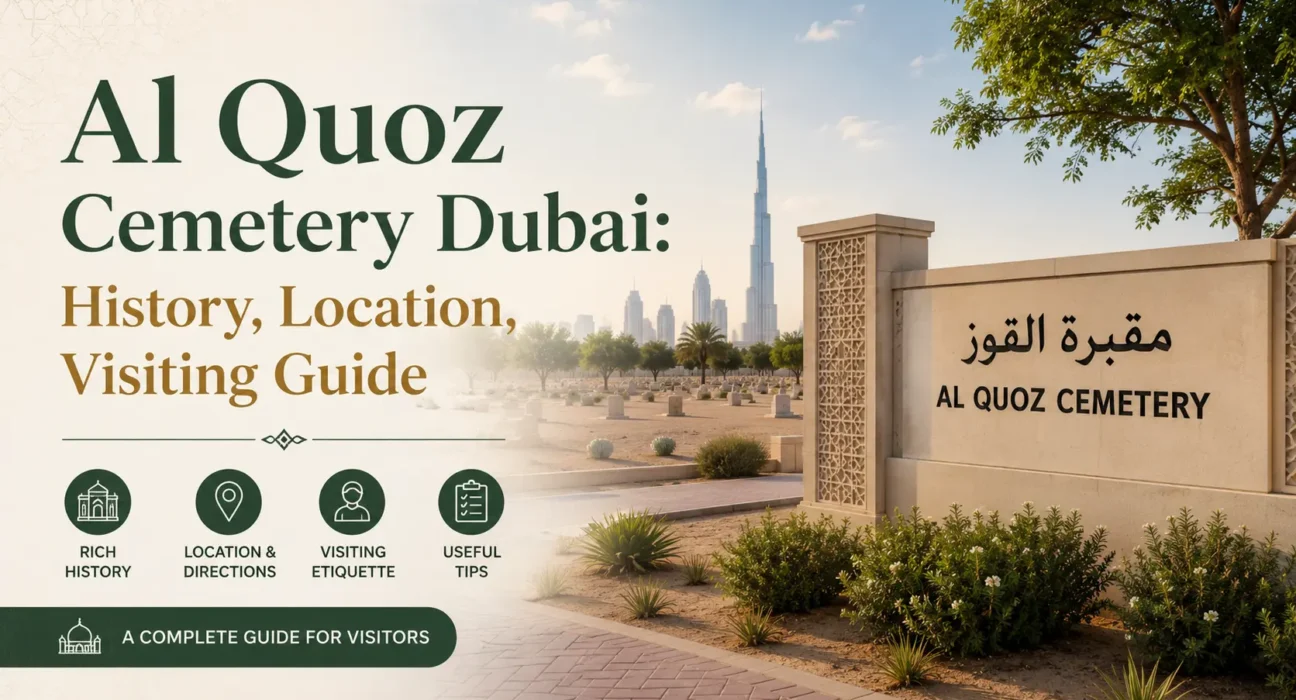
Al Quoz Cemetery is one of the most historically significant and popular Islamic cemeteries in the UAE, located in the heart of the city of Dubai. Dubai is famous for its dazzling skyscrapers, glamorous malls and futuristic architecture, but it also has quiet, very human places – and among them, Al Quoz Cemetery is one of the most profound.
Locally referred to as Maqbara Al Quoz (مقبرة القوز), this cemetery has been home to thousands of Muslims, both Emirati citizens and expatriates, who have lived, worked and died in Dubai. It is a place that is common to all irrespective of national and linguistic boundaries and social status under the banner of Islamic burial practices.
Al Quoz Cemetery is by far the main choice for residents who need to find an Islamic cemetery in Dubai or a Muslim graveyard in UAE or burial services in Dubai. It serves as a pillar of community grief and remembrance, and spiritual closure, in a city where more than 85% of the population is composed of international expatriates.
Historical Background & Significance
The entire district where the cemetery is located—the Al Quoz—is among the oldest industrial and residential areas in Dubai. During the oil boom era of the 1970s and 1980s, the city grew at a rapid pace and Dubai’s population grew with laborers, professionals and families from all over South Asia, the Arab world, Southeast Asia and beyond.
The increase in population resulted in the need for formal burial facilities in keeping with Islamic burial traditions. This was the need of the time and to address this need Al Quoz Cemetery was established as a dignified cemetery with a Muslim orientation to perform burials based on the Sunnah of the Prophet (PBUH).
Through the decades it has grown in size and is now different in its administrative management, yet its mission is the same to provide a sacred and respectful space for the Muslims of Dubai. This cemetery has also become a place of history and memory; a memory for the various mosaics of communities that were used to construct modern Dubai.
Location & How to Get There
Al Quoz Cemetery is situated in Al Quoz 1, one of the 4 sub-communities of Al Quoz in Dubai. The cemetery is situated near Sheikh Zayed Road (E11) which is one of Dubai’s main arterial roads, thus making it accessible from most areas of the city.
Key Location Details:
- Area: Al Quoz 1, Al Quoz District, Dubai, UAE
- Closest metro station: Business Bay metro station (red line) – about 10-15 minutes taxi ride
- Sheikh Zayed Road (E11) and Al Asayel Street are the major road accesses.
- Coordinates: Approximately 25.1763° N, 55.2274° E
Private car users can park in the areas to the right of the entrance to the cemetery. There are also plenty of taxis and ride-hail services such as Careem or Uber, which can take visitors to the gates of the property.
For individuals who use public transport in Dubai, the RTA bus network also provides several bus routes to Al Quoz, so it is not difficult to reach this destination even if you don’t have your own car.
Cemetery Sections: North, Center, and South
Al Quoz Cemetery is a large graveyard covering a large amount of land area to ensure that the Muslim population in Dubai, which is large and growing, will have the space they need for burial. Unlike the Western countries where the tombstones may be elaborate, ornate or personalised sculptures, the graves here are in keeping with Islamic burial convention — simple, modest and uniform.
Main elements of the layout:
- Simple grave markers: Small stone slabs or concrete mounds inscribed in Arabic or native language of family with the name and date of the deceased person’s death.
- Gravestones are all turned towards Qibla (direction of Mecca) as per Islamic laws.
- Organized rows: Graves are lined up in orderly rows to allow for ease of access and maximum utilization of space
- By nationality/community: All burials are in the Islamic way, but certain parts of the cemetery are informally connected with South Asian (Pakistan, Indian and Bangladesh) communities, Arab countries, Southeast Asian and African communities.
- Minimalist Islamic approach to burial spaces: The cemetery lacks shade structures, leaving it mostly open and reflecting the minimalist Islamic approach to the environment.
- Administrative office: There is an office or contact on the premises to coordinate with Dubai Municipality for burial registration, etc.
The atmosphere is serene and reverent, fostering a space for contemplation, du’aa (supplication) and quiet remembrance.
Islamic Funeral Practices
The Al Quoz Cemetery is a cemetery that is fully run in accordance with Islamic Sharia which differs from other religious or secular burial practices. These practices help to put into perspective the atmosphere and purpose of the space.
Observed Core Islamic Practices in Burials:
- Ghusl (ritual washing): Body washing before burial by trained people of the same sex to the deceased.
- Kafan (shrouding): The body is covered with simple white cloths (no elaborate coffins or adornments)
- Family, friends and sometimes members of the community perform funeral prayers (Salat al-Janazah) before burial.
- Quick burial: Islam insists on burying the dead as soon as possible, usually within 24 hours of death.
- No ornate tombstones: Islam does not allow for elaborate and showy markers or ornamentation on graves.
- Quran recitations: Quran Surahs Al Fatiha and Surah Yaseen are a common practice among the family and visitors to recite at the graveside.
- No mixing of graves – male and female bodies are laid in different parts of the cemetery
In sum, Al Quoz Cemetery is a place of strict faith, where these practices link the Muslim diaspora in Dubai with its spiritual roots around the world and reinforce centuries-old traditions.
Who Can Be Buried at Al Quoz Cemetery?
- One of the most frequently asked and vital inquiries for Dubai’s expats relates to eligibility for burial at Al Quoz Cemetery.
- The cemetery will be for Muslim burials only. Non-Muslims are generally sent to other cemeteries run for their faith or repatriated to their home countries when they die in Dubai.
- Burial Eligibility Criteria:
- The deceased should be a Muslim and this should be verified by documentation or family attestation.
- Death certificate issued by Dubai hospital/relevant authority is required
- Certificate of No Objection (NOC) / death clearance by Dubai Police may not be required
- For foreigners, coordination is done between the embassy/consulate of the deceased’s country and Dubai Municipality.
- Repatriation vs. local burial: Both is possible and supported by family members of the deceased – choose repatriation to home country or burial locally in Dubai.
Dubai Municipality’s Public Health and Safety Department regulates all burials and guarantees adherence to the health regulations of the region at the same time as Islamic law.
Visitor’s Rules & Etiquette
Al Quoz cemetery has laid down certain regulations in order to ensure the sanctity and tranquillity of the place. The etiquette of Dubai’s cemeteries is based on Islamic teachings and the guidelines established by Dubai Municipality.
Visitor Guidelines to Follow:
- Dress Modestly: Men and women are required to wear conservative attire; women are required to cover their hair as a symbol of respect.
- Keep noise levels to a minimum – any noisy conversations, mobile phone calls and disruptive behavior is highly undesirable.
- Photography: Photographs are not usually allowed inside the cemetery.
- Children must be supervised: Families visiting with children should make sure the children conduct themselves in a respectful manner in the grounds.
- Don’t walk on the graves: It is very disrespectful in Islam to step on or walk on the grave mounds.
- Visits on Friday are encouraged: Many Muslims will visit their cemeteries on Fridays, which is a blessed day in Islam, to pray for the deceased.
- No food or drink inside: It’s not appropriate to eat or drink inside the cemetery grounds.
- Stay clean: It’s not acceptable to litter inside or near the cemetery and is not socially acceptable.
Typically, visits occur during the day, but there may be time restrictions imposed by Dubai Municipality, and this can change with the seasons.
Role of Dubai Municipality (DM) in the Management of Cemeteries
Al Quoz Cemetery is managed and administered by Dubai Municipality, which is responsible for all public health, land planning and community welfare services in Dubai.
Dubai Municipality ensures that the cemetery is:
- Maintained with appropriate clean-ups and maintenance of pathways and gravestones
- Managed efficiently and dealt with the requests for burial in a timely fashion, particularly in light of Islamic teachings about the importance of swift burial.
- Grew as necessary to meet the needs of Dubai’s growing Muslim population
- In accordance with the UAE federal laws on death, burial and public health
- The Municipality liaises closely with hospitals, embassies, funeral homes, and families to ensure the whole procedure from death until documentation and burial is done in a dignified and efficient way. Families should also seek help from Dubai Municipality’s 1800 900 helpline for information about how to bury the body and paperwork.
ESSE for Expatriates – Emotional & Spiritual Significance in Expatriation
Al Quoz Cemetery is much more than just a place; it is a symbol of hope and belonging for the millions of expatriates who call Dubai home, many of whom have been living in the city for decades.
The cemetery is a place of deep connection when a loved one dies away from home. Families that opt for burial in Dubai instead of transferring their loved ones back to their home countries are comforted by the knowledge that they have a peaceful and sacred place they can visit, pray, and be close to those they have lost.
The cemetery connects the dots between the South Asian Muslim communities (Pakistanis, Indians, Bangladeshis) living in the UAE and their cultural heritage. The extraordinary diversity of the Muslim ummah (community) in Dubai is reflected in gravestone Quran recitations in Urdu, Bengali, Tamil or Arabic, within these walls.
Some of the most outstanding characteristics of Al Quoz cemetery are:
- Al Quoz Cemetery is one of the few cemeteries in the UAE with the following features:
- One of the oldest and largest of Dubai: It is as old as Dubai itself and was developed at the same time as Dubai.
- Multinational burial ground: Burials for Muslims of more than 50 nations are buried here.
- Centrally located – contrary to some graveyards on the outskirts of cities, Al Quoz Cemetery is accessible from central Dubai.
- Abundant of their co-existence with industrial units, residential blocks and retail spaces, the cemetery is a quiet island of eternity in a city in constant movement.
- Host community rituals: It is used for Eidul Adha and Eidul Fitr visits to the cemeteries where big families gather and remember the deceased.
- This burial ground stands as a symbol of Dubai’s multicultural Islamic identity: No other single place in Dubai illustrates the diversity of its Muslim population than this burial ground.
Local Points of Interest & Community Context
Al Quoz Cemetery is not in a vacuum, but it is part of a community, it has a context and it has a meaning:
- A commercial hub located near the hotel, Al Quoz Mall, is also at the guests’ disposal.
- Alserkal Avenue, the famous contemporary art district of Dubai in Al Quoz industrial zone
- Several mosques in Al Quoz where funeral prayers are allowed to be conducted prior to burial.
- A green recreational area, Al Quoz Pond Park, provides an alternative to the industrial nature of the neighborhood.
- Important for death certificate processing, community health clinics and hospitals within reach.
- The surrounding area mirrors the multi-layered character of Al Quoz itself, where warehouses and galleries, mosques and cemeteries, and family homes live side by side, in a distinctly Dubai style.
Conclusion
Al Quoz Cemetery is so much more than a cemetery; a living memorial to Dubai’s multicultural Muslim population, where faith is beyond social, economic, linguistic and national boundaries. Whether you are a long-time Dubai resident, a newly arrived expatriate, or simply interested in finding out about the Islamic burial practices in the UAE, knowing about this cemetery means knowing about one of the most human aspects of one of the world’s most dynamic cities!
Al Quoz Cemetery remains today as a symbol of dignity, remembrance and continuity across generations for thousands of families, from its organization and central location to the caring administration by Dubai Municipality and the respect for Islamic traditions in burying the dead.
FAQs about Al Quoz Cemetery
Q1. Which is Al Quoz Cemetery?
Al Quoz Cemetery is situated in Al Quoz 1 district in Dubai, UAE, close to Sheikh Zayed Road and is conveniently served by public buses, taxis and private cars.
Q2. Is Al Quoz Cemetery only for Muslims?
Yes. According to the Islamic guidelines of Sharia, Al Quoz Cemetery is reserved for Muslim burials.
Q3. What papers do you need to bring for burial in Al Quoz Cemetery?
Usually a death certificate from a Dubai hospital and an NOC from Dubai Police and coordination with Dubai Municipality are required.
Q4. What time is it open at Al Quoz Cemetery?
Visiting is normally during the day. The best thing to do is to check the latest and the most accurate timings with Dubai Municipality.
Q5. Is it possible for the non Dubai residents to be interred at Al Quoz Cemetery?
Indeed, any Muslim, a resident or visitor, can be buried in Al Quoz Cemetery provided that the necessary documentation is completed.
Q6. What is the time limit for the burial after death in Dubai?
In Islamic tradition, burial must be done within 24 hours of the death, if possible, and Dubai’s traditional system is designed to support this.
Q7. Is there a facility to put elaborate gravestones in Al Quoz Cemetery?
No, Islam does not encourage elaborate tombstones. Usually just simple markers with the name and date of the deceased.
Q8. Are families allowed to go to graves at any time?
Families can come in during business hours. In the Muslim community, Fridays are special days of visiting.
Q9. In charge of Al Quoz Cemetery?
Al Quoz Cemetery is managed, maintained and developed by Dubai Municipality.
Q10. Can a body be returned or can burial take place locally?
Yes. Following the death of their family member, the families can either bury the deceased in the local soil in Al Quoz Cemetery or transport the body to their country by the embassy and airline cargo services.
Read Another Topic: Commercial Bank of Dubai Al Quoz Branch | All You Need to know