


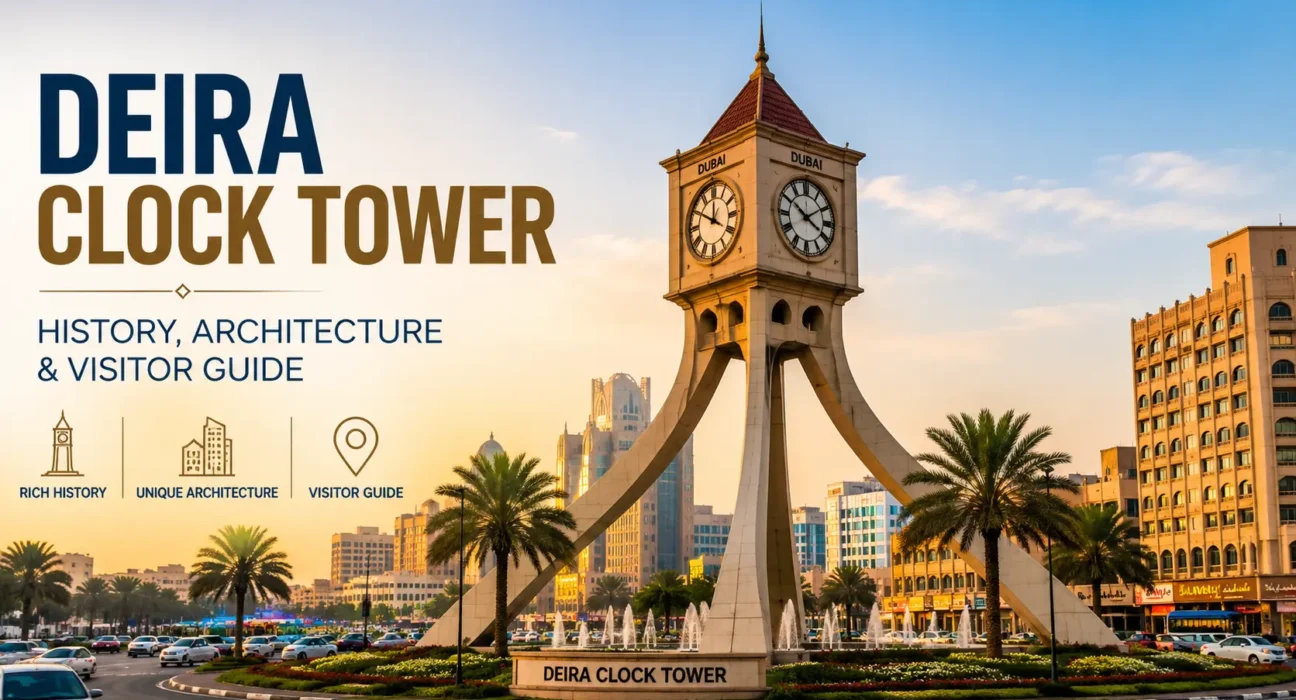
In the heart of Deira, at a bustling intersection, lies a monument that defies the rapid pace of Dubai’s progression forward. The Deira Clock Tower, also known as the Dubai Clock Tower, is one of the oldest landmark buildings in the emirate that dates back to a time before the skyscrapers, man-made islands and record-breaking towers started pockmarking the city’s skyline. To residents it is a reminder of “old Dubai”. It’s an interesting sight for visitors, and a story of how a small trading town on the Gulf coast became a global metropolis.
This guide traces the history of the tower, its designers, the problems it encountered for the past sixty years, and its significance today.
Deira Clock Tower – An Oil Discovery and An Idea
The Deira Clock Tower has two stories of its origin: one is about a clock, and one is about a tower.
It started off as a personal gift, the clock. A large ornamental clock was presented to Sheikh Rashid Bin Saeed Al Maktoum, the then Ruler of Dubai, by his son in law, Sheikh Ahmed of Qatar. This was a generous and symbolic gift, but Sheikh Rashid was faced with a problem: what do you do with an oversized decorative clock that is too large for a private home, especially when it was imported from Manchester in the United Kingdom?
His reply was the second half of the story. The broad Gulf region was experiencing a historic economic transition during this time. The economy of Dubai had been traditionally dependent on the fishing industry, and pearl diving, which had been the livelihood for the coastal people for centuries. However, the pearling industry went down drastically after the First World War and rulers of Dubai, Abu Dhabi and Sharjah started to seek oil exploration agreements. In 1962, Abu Dhabi exported its first oil, marking the beginning of a new era of trade and prosperity for the UAE, which had previously lacked oil exports.
Sheikh Rashid chose to celebrate this milestone by having the clock as the focal point of a public monument. Instead, he decided to make it public, positioning it in the very center of Deira’s trading quarter, accessible to all traders, travellers and inhabitants. That choice made a present into a memory of the country.
Deira Clock Tower Building: 1 Bucket at a Time
The tower was built in the early to mid-1960s, with most of the historical records suggesting that construction started around 1963 and was finished in a few years. Notably, different sources give slightly different completion dates (1963 or 1965), a typical feature of landmarks constructed before the formal record-keeping of the region was standardized. The one thing that is common to all of them is that this was one of the first big public construction projects in Dubai, and it reflects it.
The building techniques were very primitive compared to those of today. The concrete mixes were not available on site so the cement was mixed by hand in large concrete mix containers. Some 30 workers reportedly were involved in the labor and were working in concerted lines, each worker passing the mixed cement from hand to hand to the pouring site. Unlike the speedy builds that Dubai is famous for today, construction took place in two stages over a period of about 10 months.
It was designed and engineered by an architect who is often named in historical documents as Ziki Homsi (or in some documents as Zaki Al Hamsi), and who was instrumental in forming Dubai’s early architectural character. The team, working with designer Otto Bullard, developed a structure which had to have a very particular and functional purpose other than the display of a clock.
Design Philosophy: Function Wrapped in Symbolism
Among the design elements that often go unappreciated: the Deira Clock Tower was not only designed to be impressive, but to also be safe in the middle of a busy roundabout.
A sense of openness was a guiding principle of the architect. The site of the tower was directly in the middle of major roads, so there was a need to ensure that the tower would not be in the line of sight of drivers coming from all directions. The final design was one that provided visual reach while being both functional and transparent to traffic, and thus was the first of its kind in the City at the time.
It was more than just decoration – it was the first genuine melding of architecture and urban planning in Dubai, before the term “smart city” would even be applied to the emirate.
The First Interdistricial Gateway is located in the Town
To understand the importance of the Deira Clock Tower, it is important to understand where it is located. Located at the intersection of Umm Hurair Road and Al Maktoum Road, right next to Al Maktoum Bridge, the first land link between Deira and Bur Dubai.
Until Dubai constructed more bridges, tunnels and highways, this roundabout was the hub for almost all traffic to pass between the two historic trading areas of the city. When the Sheikh Zayed Road corridor was not yet a reality, the crossroads was the busiest one in Dubai and the clock tower was the unofficial gatekeeper. The tower would be the first thing that travelers to Deira from Bur Dubai — or vice versa — would see, both literally and symbolically, as a marker of their arrival.
The tower holds its value even today, with dozens of bridges, metro lines and highways criss-crossing the city. It is still located at a major intersection and the roundabout nearby is a familiar landmark to anyone using Deira.
The 1989 Rebuild and Corrosion Problem
As with any building constructed using 1960s technology, the Deira Clock Tower has suffered from aging.
The original construction was done with steel strengthening and in a coastal city where the humidity and salt in the air was quite high, the steel began to rust rather quickly. Several sources cite noticeable deterioration in the early 1970s through cracks and rust in the tower’s structural integrity. The original concrete mix contained beach sand and was salt-laden, which only added to the damage.
In the late 1980s the deterioration was so severe that a complete reconstruction was necessary. Due to the steel-reinforced part’s susceptibility to corrosion, Dubai Municipality rebuilt the tower in 1989 with better concrete technology. This rebuild is widely recognized as the most significant preservation project in the tower’s history, as the landmark would not have likely made it into the modern world without the rebuild.
The clock faces, which for decades were adjusted by hand, were introduced to signify modern progress. That was until November 2008 when dials from the Swiss watchmaker Omega replaced all four clock faces. What was new was that these faces were now equipped with the ability to synchronize with GPS, which allowed the tower’s time display to be automatically correct without manually adjusting it at the site.
It was a minor yet significant improvement, and a landmark that changed Dubai’s face to that of modern trade was changed face itself decades later.
Recent Renovation and Ongoing Maintenance
Well into the 2020s the Deira Clock Tower has been the focus of attention. While Dubai Municipality has taken efforts to maintain the tower’s original historical and architectural features, rather than replacing them, the roundabout decoration was enhanced with landscaping changes, a new fountain and modern multi-coloured lighting around the roundabout. The city’s investment in the renovation is estimated to be in the millions of dirhams, which is indicative of the importance placed on this heritage.
These upgrades also have been infiltrated by technology. The revamped fountain area is said to feature smart sensors that can adjust the water jets based on the wind speed, a gentle reminder of Dubai’s overall goal of seamlessly melding historical landmarks with modern “smart city” features.
The significance of the tower was further accentuated as Dubai’s Crown Prince, Sheikh Hamdan bin Mohammed, unveiled a citywide initiative to preserve dozens of historic buildings and sites built between the 1960s and the 1990s, and the Deira Clock Tower has been included.
The Deira Clock Tower Today: A Relevance Revealed
The survival of the little concrete tower from the ’60s is remarkable in a city that is constantly being demolished and rebuilt. However, it is not only important according to age.
For many old-timers, the tower stands as a reminder of the “before” version of Dubai, when record-breaking buildings and glass towers were not the norm. It provides some context that the sky scrapers don’t have for the new person or tourist. From that roundabout you can see a real history of Dubai’s development from a fishing and pearling economy to an oil one, and now a global centre for trade and tourism.
It’s also one of the few landmarks that has remained useful. Many historic monuments turn into purely ceremonial, and are fenced off and shot from afar. The Deira Clock Tower, on the other hand, remains standing at an active and busy roundabout, continues to show the correct time and is still directing traffic as it did over 60 years ago.
Deira Clock Tower Today
Its central location (close to Al Maktoum Bridge, which links Deira with Bur Dubai) makes the tower easily accessible. It is located near some of Deira’s most traditional districts such as Al Rigga with its blend of aging residential structures, cafes and shopping.
It is not a monument surrounded by a fence so most visitors view it and take photos of it either from a pavement nearby or from the car as they drive up to it. The area around the tower is well linked to roads and the tower is a good landmark if you want to visit Deira’s old commercial souks or streets, or go towards Dubai Creek.
Anyone interested in Dubai’s architectural evolution should combine a visit to Dubai’s Deira clock tower with a stroll through the historic districts of Deira, near the Creek, to get a better sense of what Dubai looked like and how it worked before the days of mega malls and supertall towers.
Final Thoughts
Deira Clock Tower is not the tallest or flashiest or most photographed landmark in Dubai — let alone. It was the result of a personal gift, it was the result of a historic oil discovery, it was created by hand with primitive tools, it was almost lost through corrosion and it was rebuilt, not once, but again and again, to keep up with the fast changing city. There’s hardly another structure in Dubai that has such a depth of layered history in such a small volume.
The next time you are driving between Deira and Bur Dubai, stop at this roundabout. But this is not simply passing a clock, but a moment of Dubai’s history.
Frequently Asked Questions
1. In which area is the Deira Clock Tower?
It is located in Deira on the junction of Umm Hurair Road and Al Maktoum Road, right next to Al Maktoum Bridge that connects Deira and Bur Dubai.
2. When was the Deira Clock Tower built?
There are a few differences in the various accounts, but it seems that construction began sometime in the early to mid-1960s, and was completed within a couple of years; most sources put building at 1963.
3. Who was the architect of the Deira Clock Tower?
Ziki Homsi, who designed the tower with designer Otto Bullard, is responsible for the design, during the early days of modern urban development in Dubai.
4. What is the reason for the construction of the Deira Clock Tower?
It was designed to display a clock presented to Sheikh Rashid bin Saeed Al Maktoum and to celebrate UAE’s first oil export in 1962, a pivotal economic shift in the nation’s history.
5. What was the reason for the rebuilding of the tower in 1989?
Dubai’s humid and salty coastal climate caused corrosion of the original steel reinforced structure, gradually softening the concrete. Rebuild in 1989 with better more durable concrete.
6. What are the clock faces made of today?
All four faces of the clock now have Omega dials with GPS synchronization for automatic time accuracy since November 2008.
7. Is Deira Clock Tower still in its original form?
Not entirely. Over the decades it has been structurally rebuilt and the clock faces replaced, and the landscaping has also been enhanced, while its outward appearance has been maintained.
8. Can the public visit the Deira Clock Tower?
Mostly used as a landmark, it is not really a tourist attraction, and tourists don’t normally go inside, but rather look at and photograph it from nearby streets.
9. Apart from the Deira Clock Tower, what are other attractions nearby?
Near Al Rigga’s shopping and dining streets, Dubai Creek and other historic areas of Deira, which can be integrated into a larger heritage walk.
10. What is the importance of the tower in the history of Dubai?
One of Dubai’s oldest major public monuments, it represents the transition from a pearling and fishing economy to an oil-based port city, and is one of the few remaining links to Dubai’s pre-skyscraper days.
Read Another Topic: Deira City Centre Bus Station Dubai | A Comprehensive Guide