

Dubai is internationally recognized by the advanced skyscrapers, the world record attractions, and the high quality of life. However, behind the shone of the skyscrapers, there is a rich cultural and spiritual heritage that was a forerunner of the city long before it was turned into a modern metropolis. One of the most significant religious and historical symbols in the UAE of the traditions that remain to this day is the Grand Bur Dubai Masjid, commonly referred to as the Bur Dubai Grand Mosque. This is the all- inclusive guide to the history of the mosque, the architecture, cultural worth and the visit tips, all that you need to know about this valuable monument in Old Dubai.
Grand Bur Dubai Masjid has a Rich History
The history of the mosque dates back to the early twentieth century, when the mosque was first constructed in the form of a kuttab (Quranic school). Children of the local neighborhood visited this place to study Quran, Arabic and Islamic values. In the long run, due to the expansion of Bur Dubai, the mosque was reconstructed and expanded to fit the increasing number of people in the community.
This building was finished in 1998 replacing a previous one but with special attention to the traditional Emirati themes in architecture. Although the mosque was built more recently, the spirit of the old one is till preserved and an old and new harmony has been created. The mosque has been used over several decades as an assemblage of families, traders along the Dubai creek, and the worshipers of nearby souks. It was critical in the development of spiritual identity of one of the oldest community in Dubai.
Geographic Area and Environment
The Grand Bur Dubai Masjid is situated on the center of the Bur Dubai Historic District, which is among the oldest neighborhoods in the city. This is a cultural hot spot containing heritage sites such as:
- Al Fahidi Historical Neighborhood
- Dubai Museum Al Fahidi Fort
- Dubai creek and the conventional abras (water taxis)
- The Textile Souk
- The temple district and Hindi lane
A key spiritual centre in the initial trading period in Dubai was the mosque, whose position was strategic as it was close to the creek. It exists today to add heritage to the district, receiving the attention of worshippers and tourists who want to visit Old Dubai. Serving commercial business The area would be served by Dubai Metro near the stations Al Fahidi Station and Al Ghubaiba Station, buses, taxis, and even by traditional boats across the creek, Deira.
Design and Characteristics of the Architecture
Exterior Architecture
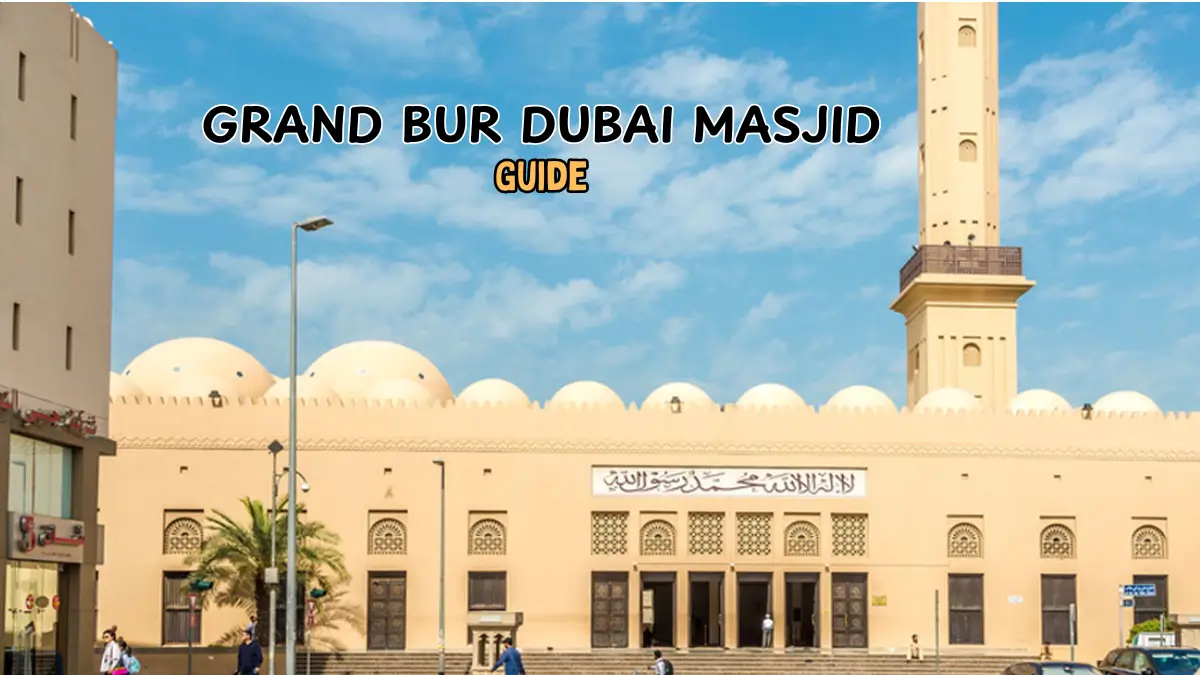
Grand Bur Dubai Masjid depicts the traditional Emirati sensibilities through the exterior. the building is painted in delicate sand-colours, and harmonises extremely well with the older architecture of the old part. The towering minaret which rises to almost 70 meters is the most outstanding characteristic in this neighborhood and is regarded as one of the tallest minarets in the older parts of Dubai.
Its structure is similar to a conventional lighthouse, which signifies both direction and light, which is an architectural symbolism of the purpose of a mosque in spiritual life. The design is made with arched windows, wooden doors that are carved, and adorned stone designs, contributing to the authenticity of the design. The modest color scheme and minimalistic geometrical shapes emphasize the beauty of the mosque without any flaunt.
Interior Structure
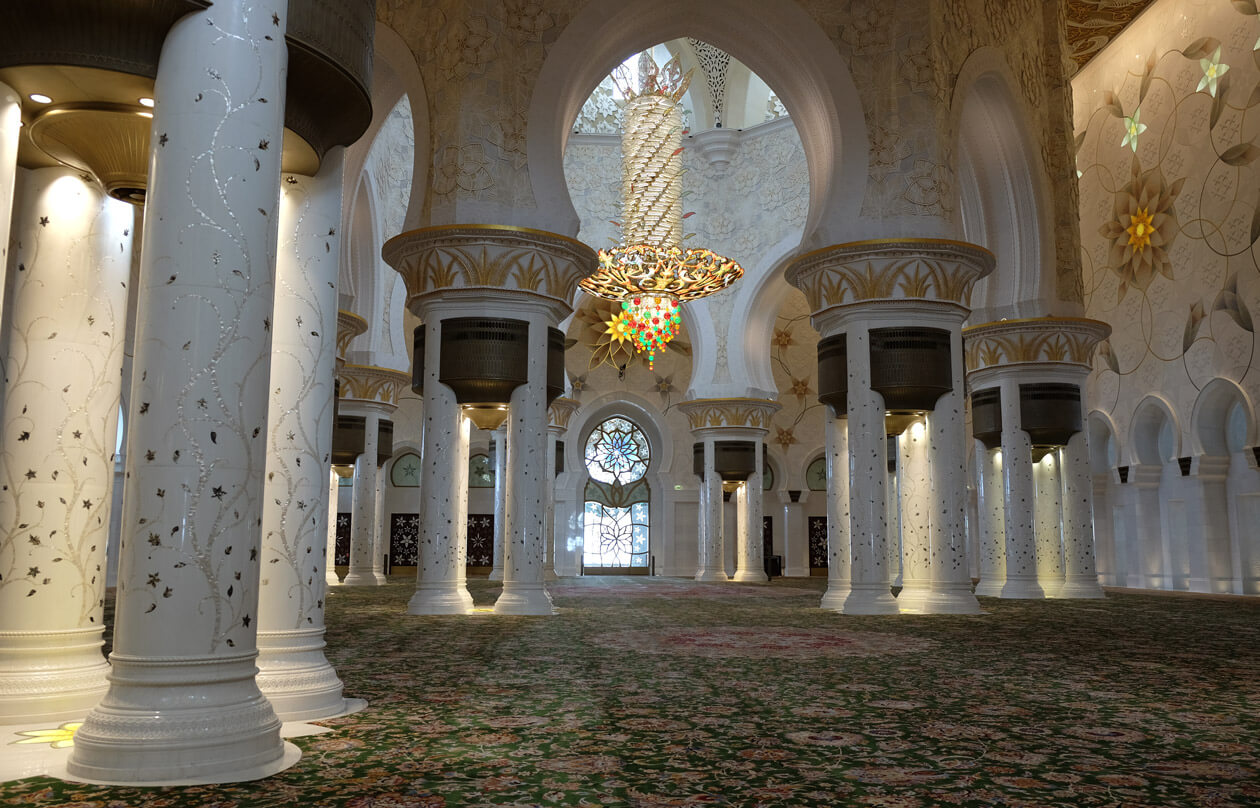
The interior design of the mosque is peaceful and noble and with a focus on worship and thought. The large central place of prayer has:
- Luxurious, soft carpeting
- Beautiful calligraphy in the walls
- Open areas that have traditional lantern-type lighting
- Columns with the effect of a visual rhythm and with the help of the wide layout of the hall
The use of Islamic geometric designs in the mosque signifies the use of non-figurative religious art dating back to time immemorial. A well-planned design and natural ventilation is what makes the worshippers comfortable during the year.
Capacity and Facilities
The Masjid of the Grand Bur Dubai has the capacity to serve more than 1,200 worshippers simultaneously. It includes:
- Praying sections between men and women
- Modern amenities ablution areas
- Classrooms used to teach the Quran
- A yard that is used when people have big parties, particularly on Fridays and during Ramadan
Mosque has managed to combine the traditional and modern functionality that is comfortable and at the same time culturally genuine.
Cultural and Religious Meaning.
The Grand Bur Dubai Masjid has been acting as a spiritual anchor to the community over decades. It hosts:
- Five daily prayers
- Friday Jummah prayers
- Taraweeh and Ramadan special prayers
- Religious classes and Quran reading
In addition to prayers, the mosque enhances social connections by encouraging human values of compassion, generosity and cohesion. It is regarded by many Emiratis as a symbol of the soul of Old Dubai the humble, spiritual, cultural richness.
Going to the Grand Bur Dubai Masjid
Visitor Guidelines
Although other mosques in Dubai are certain to give non-Muslim visitors a complete tour, the Grand Bur Dubai Masjid is mainly open to worshipers. Nevertheless, non-Muslims can observe the mosque externally or visit the district in terms of a guided heritage tour. General visitor etiquette entails:
- Wearing decently long sleeves loose garments and headwear among women
- Taking off shoes before entering prayer halls
- Keeping noise levels low
- It is not recommended to take pictures when worshipers are in the house
- Respecting prayer times
These few guidelines maintain a decent atmosphere among all.
Best Time to Visit
To see the outside and the neighborhood the visitor who is not a Muslim will find it best to visit in the early morning or late afternoon when the sun is golden hued on the traditional buildings. The mosque is especially fly by the moments of Ramadan and Islamic holidays when thousands of people are present in the mosque, which makes it a community and a party.
Accessibility for Tourists
Although when on prayers the entry is limited, the tourists who walk around Old Dubai may view the exterior of the mosque at any time. Close to it, there is the Sheikh Mohammed Centre of Cultural Understanding SMCCU where visitors can take heritage tours cultural meals and visit the mosque to learn about the Emirati culture and Islam.
The Bur Dubai Community and the Mosque
Grand Bur Dubai Masjid is not just a place of worship, but it is one of the foundations of the local everyday life. For decades, it has served as a:
- Community meeting point
- Religious education center
- Location to give out charity
- Chairman of Quran contests and cultural shows
The mosque is a meeting point of meeting place during special occasions like Eid where everyone greets the other the children play in the open courtyards and the whole district is in a celebratory mood.
Dubai is a city with numerous large mosques, and the building under analysis can be compared to them
There are numerous outstanding mosques in Dubai, which have their special characteristics:
- Jumeirah Mosque it is known to have a gorgeous white exterior and also allows open tours
- Al Farooq Omar Bin Al Khattab Mosque it is based on Ottoman-style architecture
- Grand Mosque of Al Qusais the large capacity but modernized facilities
The difference that the Grand Bur Dubai Masjid has is its value as heritage. Unlike the rest of the mosques, which have been influenced by modern or international art, the Bur Dubai Masjid reflects the traditional Emirati style, and it is a unique and valuable artifact of the Old Dubai.
Significance of the Tourism Landscape in Dubai
Despite the fact that there are modern attractions in Dubai, cultural tourists are more interested in authentic experiences. The Grand Bur Dubai Masjid can contribute to this through the provision of:
- An insight into the religious and communal life in Dubai in the first place
- A contrast to the modern skyline of the city in architecture
- An introduction to heritage walks in Old Dubai
- The distance to museums souks and historical areas
It draws tourists who are interested in seeing more than glamour of Dubai the backpacker who comes on foot the history lover who would like to know more about the history of the city.
Tips for Planning a Visit
Transportation
- The nearest one is Dubai Metro Al Fahidi Metro Station
- Abra Ride A classic wooden boat which is available at Deira to Bur Dubai takes a traditional ride
- Taxi Accessible easily in big hotels
Nearby Attractions
- Explore the Textile Souk
- Explore Al Fahidi Historical Neighborhood
- Visit Dubai Museum in Al Fahidi Fort
- Have a ride across Dubai Creek in an abra
- Have a multicultural experience around Hindi Lane
General Tips
- Visits in the morning provide access to proper lighting
- Wear walking shoes that are comfortable
- Honour prayer sessions and mosque perimeters
Future Development and Preservation.
Dubai is determined to preserve its cultural heritage, and the Grand Bur Dubai Masjid is one of the initiatives of this process. The district is concerned with restoration projects that include:
- Maintaining historical buildings
- Preservation of historical integrity on repairs
- Sponsoring community-related events
- Increasing access and preserving sacred spaces
As the city of Dubai is expanded, the mosque also serves as an element of continuity connecting the past of the city with its current bustling life.
Conclusion
Grand Bur Dubai Masjid is not merely a mosque, it is a living memory of the heritage of Dubai. Its peaceful architecture, profound historical ground and spiritual meaning make it one of the most significant points in the city. In need of a quiet spot to say a prayer or just a sightseeing tourist of the Old Dubai, the mosque can provide a true representation of the cultural and spiritual pulse of the UAE. The Grand Bur Dubai Masjid is the beacon of tradition, community and eternal faith in a city that has been known to be innovative.
Frequently Asked Questions
What is Grand Bur Dubai Masjid?
It is also among the oldest and historic mosques in Dubai that is situated in the Bur Dubai Heritage District.
What is the location of the Grand Bur Dubai Masjid?
The mosque lies in the area of close proximity to the Dubai creek, near the Al Fahidi neighborhood and the Textile souk.
Can non-Muslims enter the Grand Bur Dubai Masjid?
The non-Muslims are unable to enter the main prayer hall but can look out in the mosque and visit the heritage that is provided around.
What is the architectural design of the mosque?
It also has conventional Emirati structures including tall minaret, curved windows, and sand-coloured walls.
What is the age of the Grand Bur Dubai Masjid?
The initial structure is dated beginning in 1900s, but has been rebuilt a number of times.
How many people can the mosque hold?
The mosque is capable of hosting over 1200 worshipers simultaneously.
What are the attractions close to the mosque?
The Al Fahidi Fort, Dubai Museum, Dubai Creek, Textile Souk, and SMCCU are some of the attractions near by.
Is there a dress code to visit there?
Yes. They have to dress modestly, and they are supposed to cover the head.
Is it allowed to take pictures of the mosque?
Outside photography is permitted, however, indoors photography may be limited particularly when prayers are being conducted.
When should one visit Grand Bur Dubai Masjid?
The best time to explore the area would be early mornings and late afternoons when the area has less people and the light is favorable.