

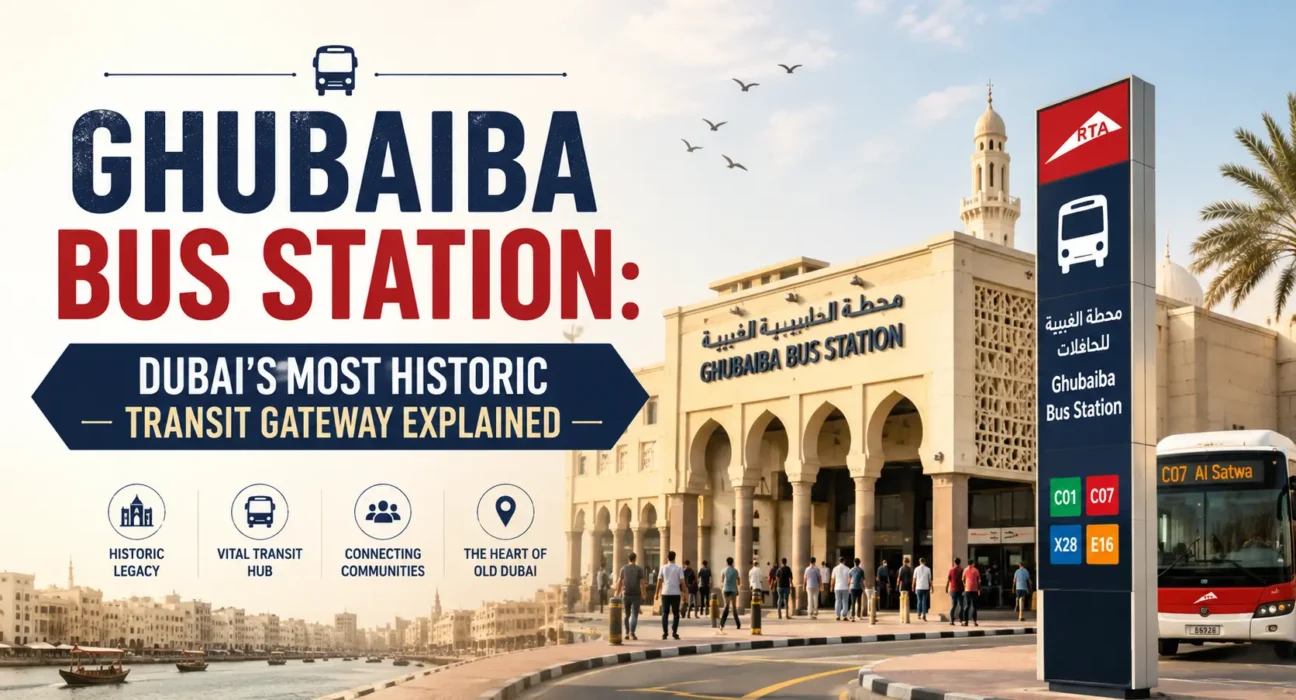
Dubai is a city that rushes towards the future at breakneck speed, but there are still spaces that are imbued with the quiet memory of where Dubai started. One of them is Al Ghubaiba Bus Station. This station, which has been ferrying workers, families, tourists and traders for decades, is nestled in the historic Bur Dubai area, just next to the shimmering shores of Dubai Creek. It’s more than just the bus stop. It’s a slice of Dubai’s living history, a bridge between old and new, a first and final destination for tens of thousands of daily commuters.
Al Ghubaiba Bus Station is a key to the workings of Dubai beneath the surface of its skyline. From its history to its exact position, local to intercity routes, facilities and even landmarks in the area and tips for travelling to and from it, this complete guide has it all.
A Brief History: Creek-Side Stop to Urban Lifeline
According to the newspaper, Al Ghubaiba Bus Station has been a vital transport hub in Dubai since it was set up in the early 90s, and was also a major hub for local and intercity buses connecting Dubai with other emirates in the region in its initial phase of operation.
The project started as a small hub near the creek and has gradually grown to become one of the most seamlessly integrated multimodal transit hubs in the UAE. Dubai grew up from its small creek-side beginnings into the sprawling developments of New Dubai – the station didn’t simply become irrelevant. Rather, it doubled down on its role as a connector. With the opening of the Dubai Metro Green Line and the introduction of Al Ghubaiba Metro Station as a stop on the route, the bus terminal was catapulted into a second life as a node within an integrated, comprehensive transport network.
It has been vastly upgraded over the years to modernize facilities and has gained fame for its strategic location between the Dubai Creek and Al Fahidi Historical Neighborhood, and has remained an important component of Dubai’s public transport system particularly since the advent of integrated systems such as the Dubai Metro and Waterbus.
The station serves an estimated 15,000 passengers on an average day today, which says a lot about the fact that it remains relevant within the city boasting several hundreds of transport solutions.
Exact Location: Finding Your Way to Al Ghubaiba is a book that guides you to this holy place, helping you find it with precision.
The Al Ghubaiba Bus Station is strategically situated in the Al Shindagha area, in proximity to Al Ghubaiba Street, just opposite Dubai Creek. For all those on the Dubai roadways, this makes the station the extreme west of Bur Dubai, a community that many locals refer to as the heart of old Dubai.
The station can be easily accessed from Mankhool Road, Khalid Bin Zayed Bin Al Waheed Road and Eminent Road while ridehailers and taxis are widely available which provides flexibility to commuters and visitors.
Points of interest that could be used as a reference:
- Dubai Creek (right across the station from it)
- Al Shindagha Museum (walking distance)
- Al Fahidi Historical Neighbourhood (short taxi or bus ride)
- Dubai Museum (in the vicinity)
- Meena Bazar & Textile Souq (mins away)
- City Centre Al Shindagha (nearby)
The station is located in the center of the confluence of heritage and modernity; it truly is unique. Commuters get on long-distance coaches to make the journey to Abu Dhabi, but tourists get off at the terminal and stroll down into some of Dubai’s most atmospheric streets, where century-old wind towers, traditional abra boats and spice stalls all have the same postcode.
Directions to Al Ghubaiba Bus Station
What makes the station special is the number of routes to reach it. An amazing integrated transport system has been developed in Dubai and Al Ghubaiba is at the heart of it.
Metro: Al Ghubaiba Metro Station is located on Dubai Metro’s Green Line, which links important old Dubai areas.
The station is located near Al Ghubaiba Bus Station which provides intercity bus services to Sharjah, Abu Dhabi and other emirates, and the Marine Transport Station for Abra. The metro station is within 5-7 min walking distance from the bus terminal, which makes it a convenient stop for those who are using both the metro and intercity bus services.
By Water Bus / Abra:
The old mode of transportation across Dubai Creek, the abra, is a convenient and picturesque choice for those arriving from Deira. Maritime transport is also provided by abras across Dubai Creek at Deira, which also connects directly to this area, and with the metro station just a few steps away, many commuters use a combination of the metro service and bus service to reach their destination in a relatively short time.
Taxi & Ride-Hailing:
There are many taxis available in and around the terminal. Other ride hailing apps like Careem and Uber also operate in the area. Any driver can be simply directed to the departure bays by saying “Al Ghubaiba Bus Station” or “Ghubaiba Terminal, Bur Dubai”.
Local Bus:
Several local RTA bus routes pass through or end at the station, ensuring it is easy to reach from almost anywhere in Bur Dubai and beyond.
Bus Routes is a local service that keeps Dubai moving.
The RTA runs a comprehensive and extensive network of local bus connections between Al Ghubaiba and key residential areas, business centres, shopping centres and transport hubs throughout the emirate. Local routes from Al Ghubaiba Bus Station lead to malls, clinics, airports, metro stations, and densely populated regions, and are frequented on a daily basis by workers, students and visitors.
Al Ghubaiba is the source of the following important local routes:
- Route 9 — Accesses Business Bay Metro Station, through major commercial hubs
- Route 29 — goes towards Dubai Mall, one of the world’s most-visited shopping malls
- This is route 93 to services Mall of the Emirates in Al Barsha.
- Route 44 – covers residential and commercial areas in Bur Dubai and Karama
- Route 32C passes through a number of inner city neighbourhoods.
- Route C01 – Central Business District route (Al Ghubaiba to Dubai Mall main entrance)
The city routes are the lifelines for thousands of blue-collar workers, students and residents who rely on cheap and speedy public transit to reach workplaces scattered throughout Dubai’s vast territory.
Intercity Routes: Dubai to the rest of the UAE
Al Ghubaiba’s real strength lies in its intercity network. Passengers can get on air-conditioned coaches and go to some of the UAE’s main destinations from this one terminal.
Easy bus connections from here lead to Abu Dhabi (E100), Al Ain (E201) and Sharjah (E306) with fares being reasonable.
Finish the Intercity Route Overview:
One of the busiest and most heavily used intercity routes in the UAE is E100 between Dubai and Abu Dhabi. The bus is a good choice from Al Ghubaiba Bus Station to Abu Dhabi with a fare of $7 – $11 and a travel time of around 2 hours 20 minutes. This is a great deal considering how much it cost to travel by taxi.
E201 — Dubai to Al Ain:
Links the coastal metropolis with the inland garden city, a popular route for workers and families going between the two.
E306 — Dubai to Sharjah (Al Jubail Bus Station):
Most common route between Bur Dubai and Sharjah, buses take about 1:40 hrs to reach their destination, depending on traffic conditions during the day. The cost of a ticket for the E306 Sharjah (Al Jubail) is around AED 15.
Routes to Ajman and Ras Al Khaimah:
There are other northern emirate connections which provide flexibility for workers and residents to travel to Ajman and Ras Al Khaimah on a weekly or weekend basis. The journey from Al Ghubaiba to Ras Al Khaimah is a popular one, and it takes approximately 2 hours and 30 minutes by bus. Buses are comfortable and have air conditioning, as well as being much cheaper than a taxi.
Routes to Fujairah:
This route is popular with workers in the industrial zones and logistics hubs along the Gulf of Oman coast in the Emirate of Fujairah.
The UAE’s universal smart transit payment, NOL card, is used for all intercity fares.
The opening and closing times of the Station: When Does the Station Run?
Al Ghubaiba Bus Station opens early in the morning with station access starting around 5:00 AM, catering to early commuters and tourists. There are convenient options available for local and intercity travel with most of the local bus services running until midnight and intercity bus services stopping usually at 11:00 PM.
For local buses the station is open all day and for intercity buses there are fixed timetables. Please refer to the RTA S’hail app for updated timetables as frequencies may change due to traffic, public holidays and seasonal changes in passenger demand.
Looking for time periods to avoid:
- Morning rush: 7:00 AM – 9:30 AM
- Evening rush: 5:30 PM – 8:30 PM
These times may be where there is a notable rise in queuing times at ticket counters and at boarding bays. It is highly recommended to plan the journey in a way that you will arrive 15 minutes before the scheduled departure, especially for coaches going between cities.
The facilities and amenities for passengers are in a good condition.
Al Ghubaiba bus station is not a cement yard. The RTA has been investing in infrastructure, a testament to Dubai’s dedication to passenger comfort and accessibility.
It is equipped with various facilities for passengers such as air-conditioned waiting rooms, passenger information desks, shops and snack bars, and taxi stands outside the stations.
The station has waiting rooms with plenty of seating, ticket offices, washrooms, ATMs, and eateries and drink-ups for commuters and travelers. Accessibility is also key, featuring wheelchair-friendly pathways and assistive systems for visually impaired users, ensuring the station is accessible to everyone. Digital boards and information screens provide travel information to passengers in real-time, which is helpful for them to plan their journeys efficiently and keep track of the arrival and departure of buses.
Full Amenities List:
- Indoor waiting rooms with air conditioning.
- NOL card top-up machines (on-site)
- Real-time departure boards – digital.
- Intercity travel ticket counters
- Clean, gender-segregated restrooms
- ATM machines
- Retail Kiosks and Snack-Bars
- Wheelchair-accessible pathways
- Advisory systems for visually impaired travellers
- Adjacent taxi rank
- Free parking is available on the property.Private parking on site is possible for free.
These are those properties that make your trip to Old Dubai as a tourist or as a daily worker, a functional, comfortable and dignified one.
Traveling without hassle with the NOL Card.
All fares are settled with NOL Card, which can be loaded at the station or via mobile apps, offering a handy and cashless alternative for both local and intercity travel.
Available in colourful tiers of blue, red, silver and gold, the NOL card is valid for every mode of transport at RTA and is the one most crucial tool in any Dubai commuter’s pocket. The regular Blue NOL card can be bought at the station and at various metro stations in the city for visitors.
NOL Card for Ghubaiba Station Travellers:
- Before booking on board, always check the balance – a zero balance card will delay gates
- Refill from refill stations in the terminal or through the RTA app
- On intercity routes, be sure to have enough credit, since fares are higher than local routes.
- Do not carry your card in your bag, you have to tap-in and tap-out
- Check the current NOL balance from your cell phone with S’hail app.
Nearby Attractions: Where Transport Meets Tourism
One of the most overlooked attributes of the station is being located in Bur Dubai. Ghubaiba is not only the start of a journey for tourists, but it is also an arrival at one of the richest cultural areas in the heart of Dubai.
Where to Go from Al Ghubaiba Bus Station:
Al Fahidi Historical Neighbourhood:
A maze of coral and gypsum houses, wind towers, narrow alleyways, art galleries and museums, which take you back to 19th century Dubai. Admission is free and the ambience is unique in the city.
Dubai Museum:
One of the oldest buildings in Dubai, it is located in Al Fahidi Fort and contains displays of the development of Dubai from a pearl diving village to a global metropolis.
Dubai Creek Waterfront:
Go outside the station and there’s the creek right there. A ride in an abra on the water to Deira is only AED 1 and has some of the best views of old Dubai’s skyline.
Textile Souk (Bur Dubai Souk):
A shaded street market where textiles, embroideries, and other traditional materials from Asia and the Arab world can be found, often at bargain prices.
Spice Souk and Gold Souk (Deira side):
Take a short crossing of the creek to reach the legendary souk area of Deira, where the fragrant lanes of the Spice Souk and glittering Gold Souk are just a step away.
Meena Bazaar:
The lively Indian and South Asian commercial area filled with clothing shops, jewellery shops, sweet stalls and restaurants.
Al Shindagha Museum:
A wonderfully presented and curated heritage museum showcasing the sea and pearl diving history of Dubai’s original families.
The Relevance of Al Ghubaiba Bus Station in 2026.
One might think that, in an age of ride-hailing apps and metro extension, a bus station built in the early 1990s would be irrelevant, but it’s not. The answer is that buses do things that no other mode of transport can do: they go where metro lines don’t; they go for prices that taxis can’t; and they move the working class of a city efficiently without much fanfare.
RTA’s Public Transport Agency provides a comprehensive network of buses throughout the city that travel to areas and metro stations and other emirates, carrying hundreds of thousands of passengers every day.
The centre of that network in old Dubai is Al Ghubaiba. It connects the old town centre with the new towns, suburbs. It gives a lifeline to the workers of Sharjah and Ajman, who cannot afford to live in Dubai but come here daily to work. It provides an affordable option for tourists to get around an otherwise costly city in an authentic manner. Even today, it remains the primary mode of transportation for citizens and visitors who don’t own cars to access Abu Dhabi.
The station’s multimodal connectivity with the metro and water bus system means it is no relic, but an integral part of Dubai’s multimodal transport future. The RTA’s plans for more infrastructure project improvements are an indication that Al Ghubaiba is being set up to play a major role in Dubai’s transport vision for many years to come.
Traveling the globe can be both thrilling and anxiety-provoking.First time travel can be both exciting and stressful.
- Download RTA S’hail app prior to travelling. It offers live tracking of buses, route planner and real-time updates to the timetables.
- Be ready in time for intercity buses. On busy routes such as E100 (Abu Dhabi) and E306 (Sharjah) seats do book up quickly, particularly on Friday evenings and Monday mornings.
- Dress for the heat. The distance from the metro to the bus terminal is brief and is in the sun of Dubai. A water bottle and light clothing will be helpful.
- Have correct change and/or a loaded NOL card. RTA buses do not accept cash and only the NOL card is accepted.
- Use peak-hour awareness. On intercity routes, if possible, you can avoid the busiest time by hiking before 7:30 AM or after 9:30 PM.
- Refer to public holiday calendars. Occasionally, bus frequencies and intercity connections are subject to changes in the timetables during UAE national holidays.
- Check the bay for route numbers. There are several buses starting from adjacent bays. Please check the bus number on the bus before getting on.
Here are 10 quick answers to some of the frequently asked questions about Ghubaiba Bus Station.
Q1. In which area of Dubai is Ghubaiba Bus Station?
Al Ghubaiba Bus Station is in Al Shindagha area of Bur Dubai, right across Dubai Creek, off Al Ghubaiba Street. It is near the Mankhool Road and Khalid Bin Al Waleed Road intersection.
Q2. Which metro station is closest to Ghubaiba Bus Station?
Al Ghubaiba Metro Station (Green Line) is the closest metro station about 5-7 minutes from the bus terminal.
Q3. How many hours is Al Ghubaiba Bus Station open?
Local bus services operate between about 5:00AM and midnight or later. Intercity runs from early morning till around 11:00 PM (varying from route to route).
Q4. What is the bus fare from Ghubaiba to Abu Dhabi?
The E100 bus service to Abu Dhabi will take about 2 hours and 20 minutes (may vary with traffic) and cost AED 25–40 (USD $7–$11).
Q5. Is it possible to travel from Ghubaiba to Sharjah and what’s the travel time?
Yes. E306 is located on the road Al Ghubaiba to Al Jubail Bus Station in Sharjah. The fare is about AED 15 and the trip takes about 1 hour and 40 minutes.
Q6. From Al Ghubaiba Bus Station, do I need a NOL card?
Yes. Payment for all RTA bus services, such as intercity services, is through the use of a NOL card. No cash payment will be accepted. NOL cards can be purchased and topped up at the station.
Q7. Is there a parking spot close to Ghubaiba Bus Station?
Yes, there are paid parking facilities near the bus station and close to the nearby Al Ghubaiba Metro Station.
Q8. Do the buses have air conditioning?
Dubai’s climate calls for fully air-conditioned vehicles, and all RTA’s buses from Al Ghubaiba Bus Station are fully air-conditioned, both intercity and local.
Q9. What are some of the top attractions to see in the vicinity of Ghubaiba Bus Station?
The station is easily accessible by walking or short taxi ride to Al Fahidi Historical Neighbourhood, Dubai Museum, Dubai Creek waterfront, Textile Souk, Meena Bazaar, and Al Shindagha Museum.
Q10. What is the best application for planning from Ghubaiba?
The RTA journey planner S’HAIL application (iOS and Android) is the official and the most reliable tool for planning, live tracking and checking bus timetables for all routes departing from Al Ghubaiba Bus Station.
Conclusion
Al Ghubaiba Bus Station is more than just a bus stop on the map of a city. It’s where Dubai’s past and its pragmatic present meet head-on every day. Whether it’s the workers who make the hour-long journey to Abu Dhabi before sunrise, or the tourist who disembarks from a bus onto the scented alleyways of the Textile Souk, each walk through Ghubaiba has a story to tell about a city that never forgets its place of origin, despite its rush to become.
Al Ghubaiba Bus Station is an essential addition to any traveler’s kit for their first trip to Dubai, for new residents of Dubai, or just for those who want to travel around the UAE at the lowest cost. Find out your route, load your NOL card and let Dubai’s oldest transit hub deliver you exactly where you need to be.
Read Another Topic: Hor Al Anz East Dubai – A Guide for Residents, & Investors