

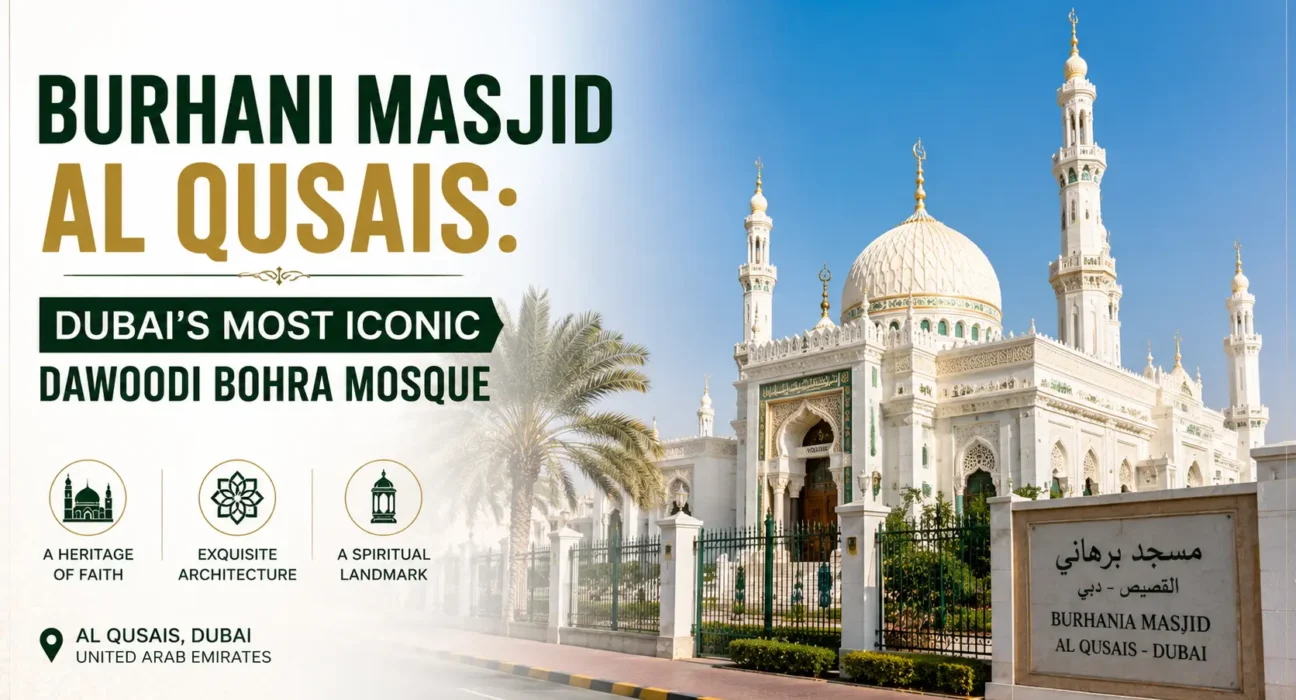
Burhani Masjid is more than a daily place of worship, nestled in the midst of the vibrant residential area of Al Qusais 1, in Dubai, along Baghdad Street. It is a testament to the Dawoodi Bohra community’s decades-long journey in the United Arab Emirates, a journey defined by perseverance, spiritual devotion, and an unwavering commitment to social responsibility.
The mosque stands majestically against a backdrop of the diverse and historically rich neighbourhood, attracting visitors and worshipers from all around the world. Burhani Masjid Al Qusais is one of the most well known Islamic sites in the Gulf region, with its wonderful Fatemi architectural style, community facilities and extraordinary spiritual legacy.
From the traveler eager to explore Islamic heritage to the researcher investigating the architecture of the Gulf to the devotee wanting to better understand the Dawoodi Bohra faith, this article provides an in-depth, updated guide to Burhani Masjid — its origins, design, community significance, and remarkable events that have graced its walls.
Identity of the Dawoodi Bohra Community in Dubai
The better you get to know the people, the better you will know the Burhani Masjid Al Qusais. The Dawoodi Bohras are a Shia Islam Ismaili Muslim community whose origins go back to Yemen and Gujarat, India. Their roots in Dubai go back to the beginning of the 1940s when the first community members – traders and merchants – arrived quietly on the shores of what was a small pearl trading port.
According to local folklore, the Karim brothers Essaji and Moosaji from Gujarat were among the first Dawoodi Bohra settlers in the area. During the next decades the community continued to grow steadily, with the emerging economy of the UAE and the visionary leadership of the founding rulers of the UAE.
In 1970 the community’s organisational identity was formally established. The Dawoodi Bohra governing body of Dubai, Anjuman Najmi, was set up at the order of the divine (farmaan) of the late spiritual leader His Holiness Syedna Mohammed Burhanuddin. Even today, Anjuman Najmi, a religious, cultural, educational and social institution of the community in Dubai is under the supervision of Anjuman Najmi and its president is Aamil Saheb.
The Dawoodi Bohra community, which numbered around 1,500 people in the early decades, is now estimated to have about 15,000 members residing in various neighbourhoods in Dubai, such as Deira, Al Qusais, Warqa, Mirdiff and Jumeirah. Their presence in Dubai is far-reaching, spanning the realms of commerce, education, healthcare, and community service.
Rooftop of a Warehouse to Grand Mosque: The Journey to Burhani Masjid
The initial meetings of the community in Dubai were rather humble. Meetings took place in the late 1970s in people’s homes or rented rooms. In 1978 a rented building near to Shabiya Power House became a community centre where nearly one hundred people would gather to celebrate special events. The first one was a warehouse with an aluminium sheet roof and only floor fans for cooling, recalled by longtime residents.
The first formal milestone was in 1984 when the first Dawoodi Bohra masjid in the Gulf region was consecrated, marking the first time in history that the community had a physical spiritual home. The masjid, Al Masjid Al Saifee in Deira, was used by the increasing jamaat up to the 1980s and 1990s.
As the number of members grew and Dubai’s urban landscape changed, however, Al Masjid Al Saifee was not enough to cater to the congregation of the community. There was a great need for a new, larger spiritual centre.
The Dubai Government very generously granted an area of land in Al Qusais in the year 2001 especially for the construction of a new mosque. The UAE leadership’s gift was a gesture of great respect and hospitality towards the Dawoodi Bohra community, reflecting the strong ties between the two communities.
The construction progressed quickly and Burhani Masjid Al Qusais was officially inaugurated by the late His Holiness Syedna Mohammed Burhanuddin, 52nd al-Dai al-Mutlaq of the Dawoodi Bohra community, on a historic day in 2004. This masjid was not simply opened, but was blessed and made one of the biggest Dawoodi Bohra mosques in the entire Gulf region.
Fatemi Design Meets Modern Excellence
The first thing that strikes visitors about Burhani Masjid is its architectural design. The mosque’s architecture is in the Fatemi style, which is very reminiscent of the Fatimid caliphate in medieval Cairo, and which holds spiritual and historical significance for the Dawoodi Bohra community.
Fatemi architecture is characterised by its:
- Complex geometric decoration — mathematical exactitude that manifests itself in stunning decoration on facades, ceilings and archways
- Slender soaring towers known as elegants minarets that flank the prayer hall and provide the skyline of Al Qusais neighbourhood.
- The interior walls are enriched with ornate calligraphy, Quranic verses and religious writings, all written in the classical Arabic script and with great reverence.
- Interior design that reflects the rich interior color palette of the masjid, where the vibrant and spiritually resonant colors further enhance the atmosphere of prayer and reflection.
- Spacious prayer halls: prayer halls are generously proportioned so that they can fit thousands of people at a time to pray, but also so that they can fit large congregational gatherings.
- Intricate geometric lattice work brings in the natural light making the prayer space an aura of serenity throughout the day.
- Separate well appointed prayer areas for women ensure women are included in the community.
- Disability access – with ramps and wide pathways, the mosque is accessible to worshippers of all ability levels.
The masjid complex also features generous parking areas (very useful in the urban fabric of Al Qusais), which are always well-maintained and remain in a quiet and serene environment, as highly appreciated by visitors. The mosque’s Google rating of 4.9 from independent reviewers is an indication of the respect that it is accorded by firsthand users.
Apart from its aesthetic quality, the design of the masjid embodies the philosophy of the Bohra community that a place of worship should cater to the complete human being – in every aspect – intellectually, spiritually and physically.
Historic First in the Gulf: Ashara Mubaraka 2004
The milestone of Burhani Masjid’s inauguration in 2004 was followed by another event that catapulted the mosque—and Dubai by extension—into the global Islamic spotlight.
In 2004, Dubai hosted the first-ever Ashara Mubaraka gathering in the Gulf region. Ashara Mubaraka is the first ten day period of Muharram, during which time Dawoodi Bohras around the world come together to remember the martyrdom of Imam Husain in a time of intense spiritual reflection, learning and unity.
When he selected the venue for that historic meeting, he selected Burhani Masjid Al Qusais which made this mosque instantly significant on the international scene. A large marquee was set up in the vicinity of the masjid complex to cater to the unprecedented number of people.
Those ten sacred days saw almost 40,000 community members from around the world descend on Dubai in a logistical task of meticulous planning, handled by volunteer committees for accommodation, transport, food, seating, and services.
Syedna Mohammed Burhanuddin alaihissallam came to Dubai as a state guest and was personally welcomed by His Highness Sheikh Mohammed Bin Rashid Al Maktoum, the then Deputy Prime Minister of UAE. The event garnered significant international interest, highlighting the Bohra community’s exceptional organizational skills and Dubai’s outstanding hospitality.
Even Greater Gathering Ashara Mubaraka 2023
20 years later, another historic event took place in Burhani Masjid Al Qusais, again placing it in the global spotlight of the Dawoodi Bohra world. After 20 years, His Holiness Syedna Mufaddal Saifuddin, the current spiritual leader of the 53rd al-Dai al-Mutlaq, decided to hold Ashara Mubaraka in Dubai again in 2023.
The scale was even more amazing this time. Some 75,000 community members took part, around 20,000 of which were from the UAE and 55,000 from around the world. The Burhani Community Center in Al Qusais was the main center from which congregational broadcasts were made, with simultaneous broadcasts to the Dubai World Trade Centre community centers in Deira, Abu Dhabi, Sharjah and Ajman and to a relay center in Kuwait, Bahrain and Oman.
His Highness Sheikh Nahyan Bin Mubarak Al Nahyan, Minister of State for Tolerance and Coexistence visited Masjid Al Burhani on 20 July 2023 to meet with Syedna Mufaddal Saifuddin. Apart from that, Sheikh Ali Al Hashimi, the Religious Advisor to the President of the UAE was also in attendance. The Minister’s presence highlighted the UAE leadership’s profound appreciation for the Dawoodi Bohra community and the masjid’s significance as a symbol of unity and harmony between faith and civic engagement.
During the visit, Sheikh Nahyan reiterated the UAE’s pledge of tolerance, co-existence, and human brotherhood, which he added was fully reflected in the gathering. Syedna Mufaddal Saifuddin, for his part, affirmed that the UAE was a land of peace, prosperity and wise leadership.
The Ashara Mubaraka at Al Qusais 2023 was not just a religious celebration; it was a testament to the UAE’s logistical prowess and the indelible ties that unite the Bohra community with their home away from home.
Community Life Education, Welfare, Sustainability Hub
Burhani Masjid Al Qusais is more than just a place of worship. The community complex that surrounds it is a vibrant multi-purpose hub of life for Dubai’s Dawoodi Bohra jamaat.
- Education: The MSB Private School, which is part of a chain of 23 MSB schools worldwide in 7 countries, is in the vicinity of the masjid complex. The school conducts regular seminars and workshops on sustainability, academic and civic excellence, values of religious devotion and worldly competence being instilled into students.
- Faiz al-Mawaid al-Burhaniyah (FMB): The masjid complex also has a state of the art community kitchen which is established under the FMB program, a global Dawoodi Bohra effort to ensure that each family in the community receives at least one wholesome, nutritious meal daily. The kitchen was modernised to meet the increasing needs of the community with modern equipment.
- Project Rise: It is a global philanthropic movement, under which residents of communities come together to engage in environmental clean-up, sustainability and civic work relevant to Dubai’s national development agenda.
- Environmental Stewardship: 80 date palm trees are indigenous trees of Al Qusais, which were personally planted by Syedna Mufaddal Saifuddin in 2023 at the end of Ashara Mubaraka in the presence of senior officials from Dubai Municipality. With this environmental leadership, the Dubai Dawoodi Bohra community has been awarded a Special Category Award in the MEWAR (Middle East Waste and Recycling) Awards 2022 for their exemplary work in environmental protection and sustainable development.
Location of the Park? How do visitors get to it?
- Address: Baghdad Street, Al Qusais 1, Dubai, United Arab Emirates
- Phone: +971 4 425 7400
- Website: dubaijamaat.org
Getting There:
- Burhani Masjid is located in Al Qusais 1, off of Baghdad Street.
- Dubai Metro Green Line has five closest stations to it, such as Al Qusais and Stadium.
- Dubai International Airport Terminal 2 is about 4km away which is around 10 minutes by car.
- There is parking available on site for the worshipers and visitors.
- Prayer Times: Emirates prayer time is followed, there are 5 prayers a day, Fajr (Sobh), Dhuhr, Asr, Maghrib and Isha.
Visitor Tips:
- The best times for more quiet visits are weekday mornings from 5:00 AM to 9:00 AM.
- All visitors must be appropriately modest and respectful in dress.
- Persons with physical disabilities can enter the mosque without any difficulty
- As a Dawoodi Bohra place of worship, users should bear in mind that prayer is practiced differently than at a Sunni mosque.
Broader Al Qusais Landscape, Burhani Masjid is Location
Al Qusais is one of Dubai’s oldest and most culturally diverse neighbourhoods, where Emirati identity and one of the city’s most diverse expatriate communities seamlessly coexist. In addition to Burhani Masjid, Al Qusais also has the Dubai Club for People of Determination, Rashid Stadium, large industrial areas, schools, parks and established residential communities.
The masjid is a building that has a character and depth that very few buildings in this area can offer. Burhani Masjid is a place of sight and soul for locals and tourists alike, showcasing what is best about the spirit of tolerance in a city where people from all over the world can build, worship and thrive.
Significance of Burhani Masjid Al Qusais
In a world where sometimes mosques are only functional places for worship, Burhani Masjid Al Qusais is a model of what a mosque can be and do when it is truly a community-based mosque. It is simultaneously:
- A holy place for thousands of worshipers every day
- A centuries-old Fatemi design tradition that has inspired an architectural achievement.
- A worldwide meeting place of one of the most organized Muslim communities in the world.
- An asset of the civic society that connects the Dawoodi Bohra community with the UAE’s national vision
- A leader in the environmental space, a trailblazer in sustainability in the very middle of Dubai
- A testament of the magnanimous and tolerant rule of the UAE — a nation that gave the land for this mosque to be built on.
Burhani Masjid Al Qusais’s journey from the warehouses of Deira to becoming a globally recognized spiritual and community hub is a story of faith and legacy.
Questions and Answers on Burhani Masjid Al Qusais
1. In which place of Dubai is Burhani Masjid?
Burhani Masjid is situated within one of the historically formed residential areas of Dubai, UAE: Baghdad Street, Al Qusais 1, Dubai, UAE.
2. Which community built and manages Burhani Masjid Al Qusais?
The masjid’s construction and administration is under the auspices of the Dawoodi Bohra Muslim community in Dubai, which is run by its official managing body, Anjuman Najmi, set up in 1970.
3. In which year was Burhani Masjid Al Qusais opened?
Inaugurated by His Holiness, Syedna Mohammed Burhanuddin, 52nd al-Dai al-Mutlaq of the Dawoodi Bohra community, in 2004, on a plot of land provided by the Government of Dubai.
4. In which architectural style, Burhani Masjid has been constructed?
The mosque has been built in the style of Fatemi architecture, which is an architectural style with its origins in Fatimid Islamic architecture and features elaborate geometric ornamentation, ornate calligraphy and elegant minarets.
5. Is it possible for non-Bohra Muslims and tourists to visit Burhani Masjid?
The mosque is usually open to visitors to admire, but it is a Dawoodi Bohra mosque. Modest dress and respectful conduct at all times is expected.
6. What is Ashara Mubaraka and how is it related to this mosque?
Dawoodi Bohra Muharram is an annual event called Ashara Mubaraka, when people commemorate the martyrdom of Imam Husain. The global event was held in Burhani Masjid Al Qusais in both 2004 and 2023, the latter of which attracted some 75,000 attendees.
7. What is the population of the Dawoodi Bohra family in Dubai?
The community has since expanded enormously, from about 1500 in the early decades to about 15,000 Dawoodi Bohra residents of Dubai today.
8. Is there parking available at Burhani Masjid?
Yes, there is a large dedicated parking facility in the mosque complex which is very well organized and always commended by visitors.
9. What efforts have the community of Burhani Masjid made to improve the environment?
In 2023, 80 indigenous date palm trees were planted in the Al Qusais community after Ashara Mubaraka. The Dubai Dawoodi Bohra community also took home a Special Category Award at the MEWAR Awards 2022 for environmental conservation.
10. Which metro station is the nearest to Burhani Masjid?
Al Qusais is located close to a number of stations on the Dubai Metro Green Line, including Al Qusais station and Stadium station. The area is also about 4 km away from Dubai International Airport Terminal 2.
Read Another Topic: EKFC Careers – Building a Future at Emirates Flight Catering