

The United Arab Emirates has long been a global pioneer in adopting cutting-edge technology to solve complex urban and industrial challenges. As part of its vision to become a world leader in the Fourth Industrial Revolution, the nation is rapidly integrating unmanned aerial vehicles into its logistics framework. The adoption of drone delivery services UAE is not just a technological trend; it is a strategic shift that offers a multitude of benefits for businesses, government entities, and the environment alike.
In a region defined by rapid growth, ambitious sustainability goals, and unique geographic layouts, autonomous flight offers a solution that traditional ground transport simply cannot match. Here are the top benefits of integrating drone delivery into the UAE’s logistics ecosystem.
Unmatched Speed and Bypassing Traffic Congestion
One of the most immediate benefits of drone delivery in the UAE is the ability to bypass the “terrestrial bottleneck.” Cities like Dubai and Abu Dhabi, while boasting world-class road networks, still face significant traffic congestion during peak hours on major arteries like Sheikh Zayed Road (E11) and Al Khail Road.
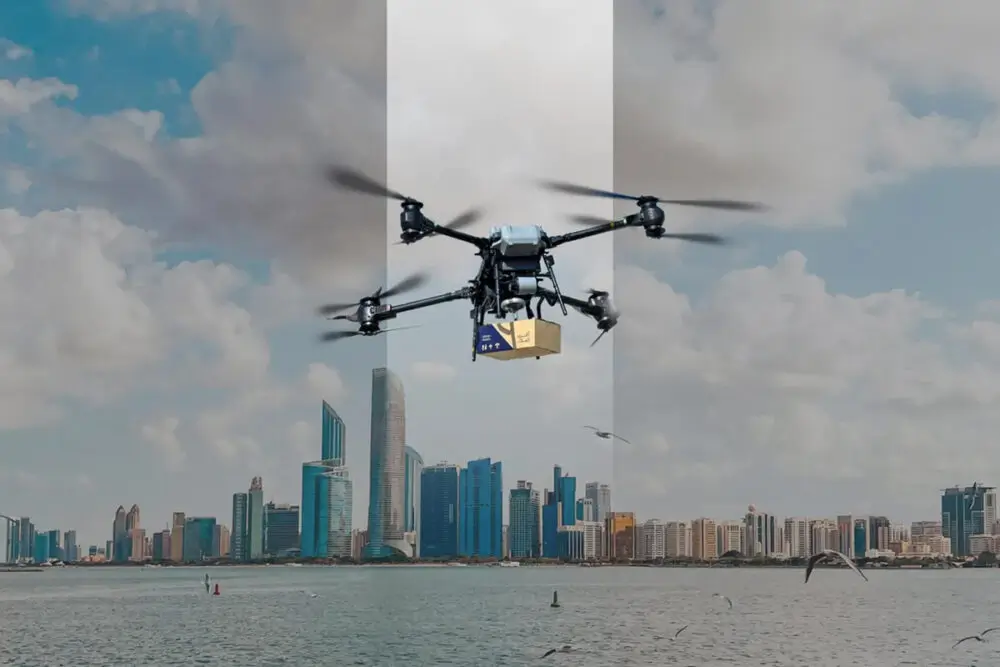
Drones operate in the “Third Dimension,” allowing them to take direct, straight-line paths from warehouses to delivery points. This reduces delivery times from hours to minutes. For time-sensitive industries such as food delivery, e-commerce, and emergency services, this speed is a game-changer that significantly enhances customer satisfaction and operational throughput.
Significant Reduction in Operational Costs
While the initial investment in autonomous technology is significant, the long-term operational savings are substantial. Traditional delivery methods require a fleet of vehicles, constant fuel consumption, intensive maintenance, and a large workforce of drivers.
Drone logistics help reduce these costs in several ways:
- Lower Energy Costs: Most cargo drones are electric or hybrid-electric, which are far cheaper to “fuel” than internal combustion engines.
- Reduced Labor Overhead: A single operator in a centralized Command-and-Control center can monitor multiple drones simultaneously, unlike trucks which require a 1:1 driver-to-vehicle ratio.
- Maintenance Efficiency: Modern drones have fewer moving parts than delivery vans or helicopters, leading to lower long-term maintenance expenses.
Advancing Sustainability and Net Zero Goals
The UAE has committed to the Net Zero by 2050 strategic initiative, aiming to achieve climate neutrality over the next three decades. The logistics sector is traditionally one of the largest contributors to carbon emissions. By shifting a portion of the freight volume to autonomous aviation drone services, the industry can drastically reduce its carbon footprint.
Electric drones produce zero tailpipe emissions, and hybrid-electric models are significantly more fuel-efficient than heavy-duty diesel trucks. Furthermore, drones reduce the “wear and tear” on road infrastructure, indirectly lowering the environmental impact associated with road repairs and construction.
Enhanced Safety and Precision
Human error is a leading cause of accidents in the logistics industry. Fatigue, distraction, and poor weather conditions can lead to road accidents that result in lost cargo and, more importantly, loss of life. Autonomous drones are governed by sophisticated AI and sensor suites that do not suffer from these human limitations.
With advanced Detect and Avoid (DAA) technology and high-precision GPS, drones can navigate complex urban environments with centimeter-level accuracy. In the UAE, where safety is a paramount concern for regulators like the GCAA, the use of autonomous systems provides a level of predictability and reliability that is difficult to achieve with manual transport.
Bridging the Gap in Remote and Offshore Logistics
The UAE’s geography presents unique challenges, including vast desert expanses and numerous offshore islands dedicated to energy production and tourism. Delivering supplies to a remote desert resort or an offshore oil rig via traditional means is often expensive and time-consuming.
Drones are the ideal solution for these “hard-to-reach” locations. A cargo drone can take off from a coastal hub and land on an offshore platform in a fraction of the time it would take a supply boat or a manned helicopter. This capability ensures that remote operations remain productive and well-supplied without the logistical headache of coordinated sea or desert convoys.
Transforming Healthcare and Emergency Response
In the medical field, the benefits of drone delivery are often measured in lives saved rather than dollars earned. The UAE is already seeing the deployment of drones for:
- Organ and Blood Transport: Moving critical supplies between hospitals during emergencies.
- Laboratory Samples: Speeding up the diagnostic process by flying samples from clinics to central labs.
- AED Deployment: Flying automated external defibrillators to the scene of a cardiac arrest before an ambulance can arrive.
The ability to move medical cargo without being hindered by ground traffic makes drones an essential tool for the modern Emirati healthcare system.
Supporting the “Smart City” Vision
The integration of drones is a core pillar of the UAE’s “Smart City” initiatives. By creating a digitalized, automated sky, the UAE is building a data-rich logistics network. Every drone flight generates data that can be used to optimize routes, manage energy consumption, and improve urban planning. This data-driven approach allows the UAE to stay ahead of the curve in global commerce, attracting international investment and fostering a culture of innovation.
Conclusion
The benefits of using drone delivery services in the UAE extend far beyond mere convenience. By embracing autonomous aviation drone services, the UAE is addressing the critical challenges of urban congestion, environmental sustainability, and operational efficiency.
As the regulatory framework continues to evolve and public-private partnerships grow, we will see an even deeper integration of drones into our daily lives. From delivering life-saving medical supplies to optimizing the “middle mile” for e-commerce, the sky is no longer a limit—it is a strategic asset. The future of Emirati logistics is autonomous, and it is already taking flight with pioneers like LODD leading the way.
FAQs
Q1: Are drone delivery services legal in the UAE?
A: Yes. The UAE has some of the most advanced drone regulations in the world. Operations are strictly governed by the General Civil Aviation Authority (GCAA) and local bodies like the Dubai Civil Aviation Authority (DCAA), requiring specific licenses and flight permits.
Q2: How much weight can a delivery drone carry in the UAE?
A: While small “last-mile” drones carry 3-5kg, industrial cargo drones like those developed by LODD can carry between 100kg and 250kg, making them suitable for middle-mile logistics and industrial parts.
Q3: Can drones fly in the UAE’s summer heat?
A: Yes. Professional-grade drones are specifically engineered with thermal management systems to handle the UAE’s summer temperatures, which can exceed 50°C, ensuring battery and avionics safety.
Q4: Will drones replace all delivery trucks in the future?
A: Not entirely. Drones are intended to complement the existing logistics network. They are ideal for time-critical, high-value, or remote shipments, while trucks will likely continue to handle bulk, non-urgent freight.
Q5: How secure is the cargo during a drone flight?
A: Cargo is housed in secure, electronically locked bays that can only be accessed at the destination by authorized personnel using secure codes or biometric verification.